中文
中文 English
 Русский
Technical Specifications
Chemical and physical specifications (agricultural grade)
| Serial number | Parameter Name | Specification Requirements |
|---|---|---|
| 1 | Product Name | Zinc EDTA |
| 2 | Chemical Formula | C₁₀H₁₂N₂O₈ZnNa₂·2H₂O |
| 3 | Molecular Weight | 435.6 |
| 4 | CAS Number | 14025-21-9 |
| 5 | Chelated Zinc (Zn) | 14.5% - 15.5% |
| 6 | pH value (1% aqueous solution) | 6.0 - 7.0 |
| 7 | Water-Insoluble Matter | ≤ 0.1% |
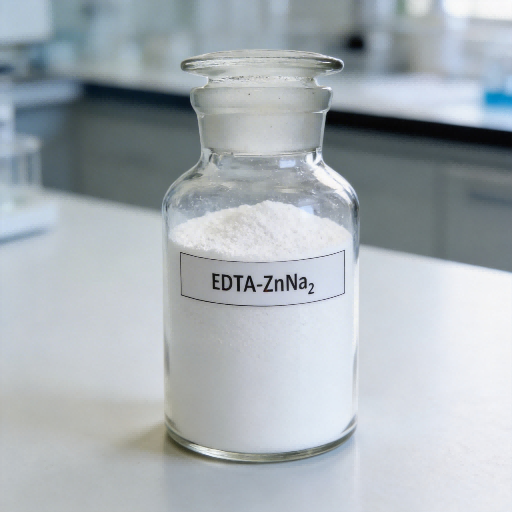
| 8 | Appearance | White Powder |
| 9 | Packaging Specifications | 25 kg bags, or packaged as per customer requirements |
| 10 | Storage | Store in a dry, ventilated warehouse, away from direct sunlight, stack lightly and handle with care. |
Physical Properties
| Project | Description |
|---|---|
| Appearance | White powder, uniform color |
| Odor | Odorless |
| Water Soluble | Fully water-soluble, dissolves quickly, no sediment |
| Particle size | 80 mesh residue ≤5% |
| pH value (1% aqueous solution) | 6.0 - 7.0 |
Product Description
EDTA Zinc Disodium (EDTA ZnNa2) is an efficient EDTA chelated zinc fertilizer. White powder, chelated zinc content 14.5%-15.5%, pH 6.0-7.0, water insoluble ≤0.1%. Produced via EDTA chelation process, zinc exists in EDTA chelated form for direct crop uptake, with absorption rate far exceeding common inorganic zinc fertilizers.
Product Features
- High Chelated Zinc Content: Zn 14.5%-15.5%
- EDTA chelation processGood stability, not easily fixed by soil
- Fully Water-SolubleDissolves quickly, no sediment or residue
- Low ImpuritiesWater insoluble ≤ 0.1%
- pH Stable1% aqueous solution pH 6.0-7.0
Applications
Agricultural Nutrients & Fertilizers
Application Guide
Drip irrigation application (recommended)
Fully Water-Soluble, Ideal for Protected Agriculture and Precision Fertilization, EDTA Chelated Zinc Can Be Directly Absorbed by Crops
- Concentration: 0.5 — 2 g/L irrigation water
- Application rate: 0.5 — 2 kg/mu/time
- Frequency: every 10 — 15 days
Foliar Spray
Quickly replenish zinc and correct deficiency symptoms, ideal for fruit trees and vegetables.
- Dilution ratio: 1:1000 — 1:2000
- Application rate: 30 — 60 L/mu
- Time: morning or evening, avoid high temperatures
Foliar/root irrigation
Apply via fertigation to supplement zinc for fruit trees, vegetables, and other cash crops.
- Dosage: 1 — 3 kg/mu/time
- Dilution ratio: 1:100 — 1:200
- Time: key crop growth stages
Water-Soluble Fertilizer Compounding
Use with water-soluble macronutrient fertilizers as a zinc source for balanced nutrition.
- Used with macroelement water-soluble fertilizer
- Addition ratio: 1–5%
- Suitable for melons, vegetables, and fruit trees
Applicable crops and recommended dosages
| Crop Type | Representative Crops | Drip Rate | Foliar Spray Dosage | Application Period |
|---|---|---|---|---|
| Fruit trees | Apple, pear, peach, grape, citrus | 1 — 2 kg/mu | 1000 — 2000 times | Germination stage, flowering stage, young fruit stage |
| Vegetables | Tomatoes, cucumbers, peppers, eggplants, leafy vegetables | 5 — 1.5 kg/mu | 1000 — 1500 times dilution | Seedling, flowering, and fruiting stages |
| Field Crops | Wheat, corn, rice, soybeans | 5 — 1 kg/mu | 1000 — 1500 times dilution | Tillering stage, jointing stage |
- Store in a dry, ventilated warehouse, away from direct sunlight, stack lightly, handle with care.
- For foliar application, it is recommended to conduct a small area test first to confirm no phytotoxicity before large-scale use.
- Can be mixed with most fertilizers and pesticides, but a small area test is recommended before use.
- Filter the solution before drip irrigation to prevent clogging of drippers.
- Control the zinc dosage to avoid overapplication, which may cause zinc toxicity.
FAQ
Typical symptoms of zinc deficiency in crops include:
- Little Leaf DiseaseNew leaves become smaller, leaves cluster
- Albino SeedlingInterveinal chlorosis turning leaves white
- Growth RetardationStunted growth, shortened internodes
- Poor Fruit DevelopmentFruit becomes smaller, quality declines
Commonly found in high pH soils (calcareous soils), soils with low organic matter content, or fields with heavy lime application.
The main difference lies in the chelation process and nutrient form:
- Regular Zinc SulfateExists as inorganic salt form, crops must convert it to absorbable form, resulting in lower absorption rate and prone to precipitation fixation with soil phosphates.
- EDTA Chelated ZincExists in EDTA chelated form, zinc is "encapsulated" by EDTA molecules, offering high stability and resistance to soil fixation, enabling direct crop uptake with absorption rate far exceeding common inorganic zinc fertilizers.
EDTA chelated zinc is especially suitable for high-pH soils and drip irrigation systems.
Store in a dry, ventilated warehouse, away from direct sunlight. Under sealed original packaging, shelf life is24 MonthsStorage precautions:
- Keep away from direct sunlight, stack lightly, handle with care
- Avoid contact with sharp objects to prevent package damage
Use soon after opening; reseal unused product for storage.
Send Inquiry
Please fill in the information below, and our business team willWithin 2 business daysWe will reply to you.
Same Series Products
More EDTA Chelated Trace Element Products to Meet Different Crop and Soil Needs