中文
中文 English
 Русский
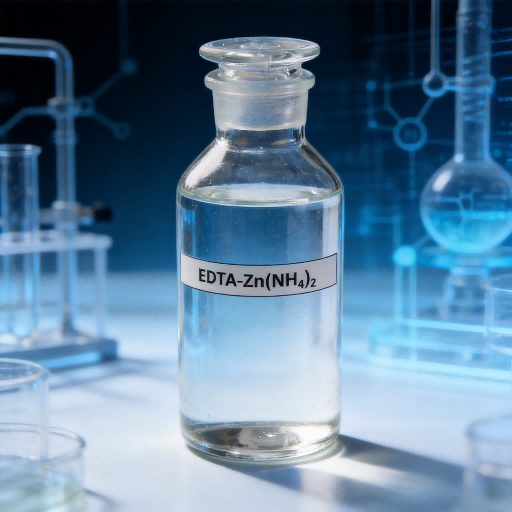
Technical specifications
Chemical and Physical Indicators (Agricultural Grade)
| No. | Parameter Name | Specification Requirements |
|---|---|---|
| 1 | Product Name | Ammonium Zinc EDTA |
| 2 | Chemical Formula | C₁₀H₂₀N₄O₈Zn |
| 3 | Molecular weight | 389.70 |
| 4 | CAS Number | 67859-51-2 |
| 5 | Chelated Zinc (Zn) | 10.0 ± 0.4% |
| 6 | pH value (1% aqueous solution) | 8.0 ± 1.0 |
| 7 | pH Value (0.1% Aqueous Solution) | 8.5 ± 1.0 |
| 8 | pH Value (Concentrate, 25°C) | 7.0 ± 1.0 |
| 9 | Specific gravity (g/cm³) | 1.34 ± 0.01 |
| 10 | Water-insoluble matter | ≤ 0.01% |
| 11 | Appearance | Light Yellow Liquid |
| 12 | Packaging Specifications | 250 kg drum, 1250 kg IBC tank, or as per customer request |
| 13 | Storage | Store in a cool place, keep container tightly closed, and store in a dry, ventilated area. |
Physical Properties
| Project | Description |
|---|---|
| Appearance | Light yellow liquid, uniform color |
| Odor | Odorless |
| Water Solubility | Fully water-soluble, dissolves quickly, no sediment |
| Specific gravity | 1.34 ± 0.01 g/cm³ |
| pH Value (Original Solution) | 7.0 ± 1.0 |
Product Introduction
Zinc Ammonium EDTA (EDTA ZnNH4) is a highly efficient EDTA chelated zinc fertilizer. Product is a light yellow liquid with chelated zinc content 10.0±0.4%, pH 7.0±1.0, specific gravity 1.34±0.01 g/cm³, water insoluble matter ≤0.01%. Using EDTA chelation technology, zinc exists in EDTA chelated form, directly absorbable by crops with much higher absorption rate than ordinary inorganic zinc fertilizers.
Product Features
- EDTA chelation processGood stability, not easily fixed by soil
- Liquid FormulationEasy to use, easy to dilute and mix
- Low impuritiesWater insoluble ≤0.01%, extremely high purity
- Fully Water-SolubleDissolves quickly, no sediment or residue
- Ammonium-Containing FormulaSimultaneously supplies nitrogen
Application Areas
Agricultural Nutrients, Fertilizers
Application reference
Drip irrigation application (recommended)
Fully water-soluble formula, ideal for protected agriculture and precision fertilization, EDTA chelated zinc can be directly absorbed by crops.
- Concentration: 0.5 – 2 mL/L irrigation water
- Application rate: 0.5 – 2 L/mu/time
- Frequency: every 10 – 15 days
Foliar spray
Quickly replenishes zinc and corrects deficiency symptoms, especially suitable for fruit trees and vegetables.
- Dilution ratio: 1:500 — 1:1000
- Application rate: 30 – 60 L/mu
- Time: morning or evening, avoid high temperatures
Foliar Drench
Apply via fertigation with irrigation water, suitable for supplementing zinc in fruit trees, vegetables, and other cash crops.
- Dosage: 1 – 3 L/mu/time
- Dilution ratio: 1:100 — 1:200
- Time: key growth stages of crops
Water-Soluble Fertilizer Compounding
Used together with water-soluble macroelement fertilizers as a zinc source for balanced nutrition.
- Use with water-soluble NPK fertilizer
- Addition ratio: 1 — 5%
- Suitable for melons, vegetables, and fruit trees
Suitable crops and recommended dosage
| Crop type | Representative Crops | Drip Irrigation Rate | Foliar Spray Dosage | Application Period |
|---|---|---|---|---|
| Fruit Trees | Apples, Pears, Peaches, Grapes, Citrus | 1 – 2 L/mu | 500 — 1000 times dilution | Budding, flowering, young fruit stages |
| Vegetables | Tomatoes, cucumbers, peppers, eggplants, leafy greens | 0.5 — 1.5 L/mu | 500 — 1000 times dilution | Seedling stage, flowering stage, fruiting stage |
| Field Crops | Wheat, Corn, Rice, Soybeans | 0.5 — 1 L/mu | 500 — 1000 times dilution | Tillering stage, jointing stage |
- Store in a cool place, keep container tightly closed, and store in a dry, ventilated area.
- When applying as foliar spray, it is recommended to conduct a small-area test first to confirm no phytotoxicity before large-scale use.
- Can be mixed with most fertilizers and pesticides, but it is recommended to conduct a small-area test before use.
- It is recommended to filter the solution before drip irrigation to prevent impurities from clogging the drippers.
- Zinc dosage should be carefully controlled to avoid toxicity from overuse.
FAQ
Typical symptoms of zinc deficiency in crops include:
- Rosette diseaseNew leaves smaller, leaves clustered
- Albino seedlingInterveinal chlorosis turning white
- Growth RetardationStunted growth, shortened internodes
- Poor Fruit DevelopmentSmaller fruit, reduced quality
Commonly found in high pH soils (calcareous soils), low organic matter soils, or fields with heavy lime application.
Main differences lie in chelate form and formulation
- Standard Zinc FertilizerPresent in inorganic salt form (e.g., zinc sulfate) with lower absorption rate.
- EDTA ZnNH4Existing in EDTA chelated form, zinc is "wrapped" by EDTA molecules, offering good stability, not easily fixed by soil, directly absorbable by crops.
- Liquid FormulationEasy to use, dilute, and mix, suitable for modern precision agriculture.
Store in a cool place, keep container tightly closed, and store in a dry, ventilated area. Under sealed original packaging, the shelf life is24 Months. Storage precautions:
- Avoid direct sunlight and high temperature
- Prevent container leakage or breakage
Send Inquiry
Please fill in the information below, and our business team willWithin 2 business daysReply to You
Same Series Products
More EDTA chelated micronutrient product options to meet different crop and soil needs