中文
中文 English
 Русский
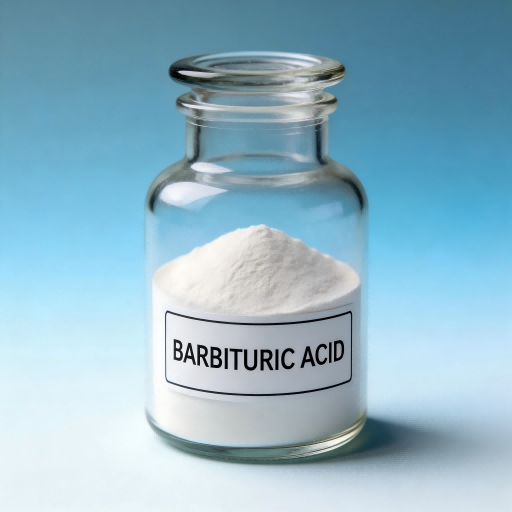
Technical Specifications
Test Parameters
| Test Item | Standard |
|---|---|
| Content | 99% Min. |
| Loss on Drying % | 0.5% Max. |
| Melting point | 245℃ |
| Sulfated ash | 0.1% Max. |
| Appearance | White Crystalline Powder |
Basic Information
| English Name | Barbituric Acid |
| Molecular Formula | C₄H₄N₂O₃ |
| Molecular Weight | 128.09 |
| CAS No. | 67-52-7 |
| Packaging | 25 kg bag, or packaged according to customer requirements. |
| Storage | Store in a dry, ventilated warehouse; avoid direct sunlight, stack lightly, and handle with care. |
Product Introduction
Product Overview
Barbituric acid is a white crystalline powder, CAS 67-52-7, molecular formula C₄H₄N₂O₃, molecular weight 128.09, content ≥99%. It is an important pharmaceutical intermediate used to synthesize barbital, phenobarbital, vitamin B12, and other drugs, and can also be used as a polymerization catalyst and dye raw material.
Product Features
- Content ≥99%, high purity quality guaranteed
- Melting point 245°C, good thermal stability
- Loss on drying ≤ 0.5%, low moisture content
- Sulfated ash ≤ 0.1%, extremely high purity
- Pharmaceutical Grade Application Standard
- White crystals, pure appearance
Chemical Properties
Barbituric acid is a pyrimidinetrione compound, with two carbonyl groups and one imide structure in its molecule. Its unique cyclic structure gives it weak acidity, allowing it to form salts with alkali metals. Barbituric acid is a key precursor for synthesizing barbiturate drugs, and its derivatives exhibit pharmacological activities such as sedation, hypnosis, and anticonvulsant effects.
Applications
Pharmaceutical intermediates
Used in the synthesis of barbiturate drugs such as barbital and phenobarbital, it is a key raw material for sedative-hypnotic drugs.
Vitamin B12 Synthesis
Used in the synthesis process of vitamin B12 (cobalamin), it is an important raw material for vitamin drugs.
Polymerization Catalysts
Can be used as a catalyst or catalyst ligand in polymerization reactions for the synthesis of specific polymer materials.
Dye Raw Materials
Can be used in the synthesis of dye intermediates and functional pigments containing pyrimidine structures.
- Store in a dry, ventilated warehouse, away from direct sunlight
- Stack lightly, handle with care, avoid packaging damage
- Keep the package sealed before and after use
FAQ
This product has barbituric acid content ≥99%, tested by high-performance liquid chromatography (HPLC), ensuring the product purity meets pharmaceutical grade standards. Low impurity content ensures efficacy and safety in various application fields.
The melting point of barbituric acid is 245°C, an important physical parameter for characterizing compound purity. High-purity barbituric acid should have a clear melting point close to the theoretical value. A low or broad melting range may indicate impurities, making melting point testing a crucial quality control step.
Sulfated ash ≤0.1% is a key indicator of inorganic impurity content in the product. Low sulfated ash indicates the product is nearly free of inorganic salt impurities, which is critical for the purity requirements of pharmaceutical intermediates. High-purity products ensure efficacy and product quality in subsequent synthesis reactions.
The molecular formula of barbituric acid is C₄H₄N₂O₃, with a molecular weight of 128.09. Its structure is a pyrimidine ring derivative, containing two carbonyl groups (>C=O) and one imide structure (-NH-CO-). This unique cyclic structure gives it weak acidity, enabling salt formation with alkali metals, and it is a key precursor for synthesizing barbiturate drugs.
Barbituric acid is readily soluble in hot water and alkaline solutions, slightly soluble in cold water and ethanol, and insoluble in ether and chloroform. Its aqueous solution is acidic and reacts with bases to form corresponding salts. Solubility increases significantly under alkaline conditions, which is a common dissolution method in pharmaceutical synthesis.
Under proper storage conditions (dry, ventilated, protected from direct sunlight), the product shelf life can reach 24 months. Store in an indoor environment at 15-25°C, keep the packaging sealed, and prevent moisture absorption. Stack gently and avoid package damage during handling.
Wear protective gloves and masks during operation to avoid dust inhalation and skin contact. In case of eye or skin contact, rinse immediately with plenty of water. Use as a pharmaceutical intermediate in a GMP-compliant environment. Refer to the product MSDS for detailed safety information.
Both are pyrimidine compounds, but with different structures. Barbituric acid (C₄H₄N₂O₃) contains two carbonyl groups and one imide structure, exhibiting weak acidity; while 4,6-dihydroxypyrimidine (C₄H₄N₂O₂) contains two hydroxyl groups. These structural differences lead to variations in chemical properties and applications, with barbituric acid primarily used in sedative drug synthesis.
Standard packaging specification is 25 kg/bag, using paper bags with inner plastic lining for effective moisture protection. Custom packaging according to customer requirements is also supported, such as cardboard drums or plastic drums. IBC tote packaging is available for bulk orders.
Send Inquiry
Please fill in the information below, and our business team willWithin 2 working daysReply to you.
Same series products
More other chelating agent product options