中文
中文 English
 Russian
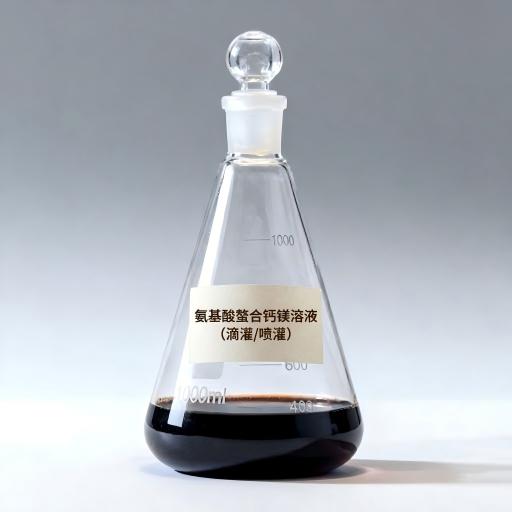
Technical specifications
Chemical and Physical Specifications (Agricultural Grade)
| Serial Number | Indicator name | Specification Requirements |
|---|---|---|
| 1 | Total Amino Acid | ≥ 400 g/L |
| 2 | Free Amino Acids | ≥ 200 g/L |
| 3 | Calcium + magnesium (Ca+Mg) | ≥ 40 g/L |
| 4 | Appearance | Clear Liquid |
| 5 | Specific Gravity | 1.22 — 1.24 |
| 6 | Water-insoluble residue | ≤ 0.5% |
Physical Properties
| Item | Description |
|---|---|
| Appearance | Clear liquid, uniform color |
| Odor | Mild characteristic amino acid odor |
| Water soluble | Fully water-soluble, dissolves quickly, no sediment |
| Specific Gravity | 1.22 — 1.24 |
| Directions for Use | Application with irrigation water, drip irrigation, micro-sprinkling |
Product description
Product overview
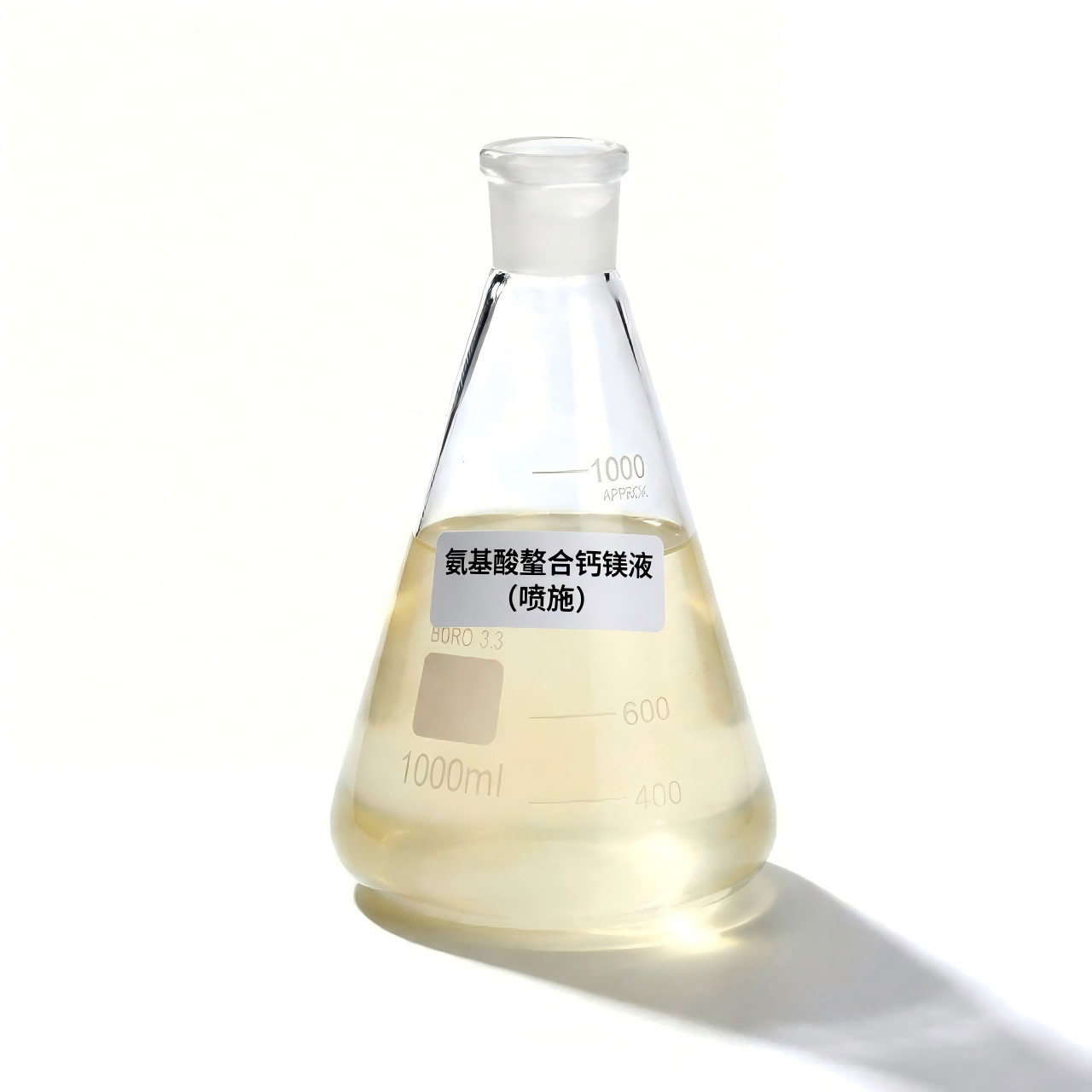
Amino Acid Chelated Calcium-Magnesium Liquid (for fertigation and drip irrigation) is a high-efficiency liquid secondary nutrient fertilizer in amino acid chelated form. Product is a clear uniform liquid. Total amino acids (AA) ≥400 g/L, free amino acids ≥200 g/L, calcium+magnesium ≥40 g/L, pH 6-8, density 1.22-1.24. Using amino acid chelation technology, calcium and magnesium are in chelated form, enabling direct plant uptake and significantly higher efficiency compared to conventional inorganic secondary nutrient fertilizers.
Key Advantages
- Calcium and magnesium complexCa+Mg ≥ 40 g/L, simultaneous application of two key secondary nutrients.
- High Amino Acid ContentTotal AA ≥ 400 g/L, free AA ≥ 200 g/L. Provides plants with rich organic nutrition while enhancing stress resistance.
- Amino acid chelation technologyCalcium and magnesium in amino acid chelate form, high stability, not fixed by soil.
- High degree of absorptionAmino acids directly participate in plant metabolism; the absorption rate of calcium and magnesium is 3-5 times higher than ordinary mineral fertilizers.
- Fully water-solubleClear liquid, dissolves quickly, no sediment, suitable for all irrigation systems.
- Prevention of nutrient deficienciesEffectively prevents calcium and magnesium deficiency symptoms such as fruit cracking, bitter pit, blossom end rot, small leaves, and chlorosis.
Comparison of Product Advantages
| Characteristics | Description | Area of application |
|---|---|---|
| Amino Acid Chelated | Calcium and magnesium are chelated with amino acids, offering high stability and bioavailability. | Prevention and treatment of nutrient deficiency symptoms, rapid replenishment of secondary nutrients |
| Calcium and magnesium complex | Calcium+magnesium ≥40 g/L, two mesonutrients applied in one application. | Synchronous application during fruit development and flowering periods |
| High Amino Acid Content | Total AA ≥ 400 g/L, free AA ≥ 200 g/L, provides rich organic nutrition. | Enhanced crop resilience and quality improvement |
| Fully water-soluble | Clear liquid, dissolves quickly, no sediment or residue | Application: drip irrigation, fertigation, fine mist sprinkling |
Area of application
Application Recommendations
Drip Irrigation (Recommended)
Fully water-soluble formula ideally suited for protected cultivation and precision agriculture. Amino acid-chelated mesonutrients are directly absorbed by plants.
- Application Rate: 5 – 10 kg/mu/application
- Dilution factor: 1:200–1:500
- Frequency: once every 10–15 days
- Note: Can be used together with water-soluble macronutrient fertilizers.
Application with irrigation water
Applied with irrigation water (fertigation), suitable for replenishing secondary nutrients in fruit trees, vegetables, and other industrial crops.
- Application Rate: 10–20 kg/mu/application
- Dilution factor: 1:100–1:200
- Timing: key crop growth stages
- Note: better to apply frequently at low dosages
Foliar feeding (spraying)
Rapidly replenishes calcium and magnesium, eliminates deficiency symptoms, especially suitable for use during fruit development and flowering stages.
- Dilution ratio: 1:800 – 1:1500
- Application rate: 30 — 60 L/mu
- Time: morning or evening, avoiding high temperature
- Note: For best results, 2–3 applications during fruit development are recommended.
Mixing water-soluble fertilizers
Used as a source of secondary elements in combination with water-soluble macronutrient fertilizers for balanced nutrition.
- Applied together with water-soluble macro-nutrient fertilizers.
- Addition ratio: 3–8%
- Suitable for melons, vegetables, fruit trees
- Can be used alone or in combination with other amino acid products.
Applicable crops and recommended doses
| Crop Type | Typical crops | Drip irrigation rate | Application rate for foliar feeding | Application period |
|---|---|---|---|---|
| Fruit Trees | Apple, pear, peach, grape, citrus | 3–5 kg/mu | 1000-2000 times | Period of young fruit set, fruit swelling, post-harvest. |
| Vegetables | Tomatoes, cucumbers, peppers, eggplants | 2–4 kg/mu | 1000 – 1500 times | Stage of Emergence, Flowering, and Fruiting |
| Melon and Gourd Crops | Watermelons, melons, strawberries | 2–4 kg/mu | 1000 – 1500 times | Vine growth, flowering, and fruit filling period. |
| Oilseed crops | Rapeseed, Peanut, Soybean | 2–3 kg/mu | 1000 – 1500 times | Flowering and Podding Period |
| Root vegetables | Potatoes, carrots, beets | 2–3 kg/mu | 1000 – 1500 times | Tuber formation and bulking stage |
- Store in a cool, dry place, avoid direct sunlight; use as soon as possible after opening the package.
- Boron content requires dosage control to avoid boron toxicity due to over-application.
- Compatible with most fertilizers and pesticides, but a preliminary small-area test is recommended.
- For foliar fertilization, it is recommended to first conduct a small-area test to confirm no phytotoxicity, then apply on a larger scale.
- Before use in drip irrigation, it is recommended to filter the solution to prevent clogging of drippers with impurities.
Frequently asked questions
Calcium and magnesium have a close synergistic relationship in plants:
- Mutual enhancement of absorptionMagnesium promotes the absorption and transport of calcium. Magnesium deficiency impairs calcium uptake.
- Joint Participation in Chlorophyll SynthesisMagnesium is a key component of chlorophyll; calcium stabilizes cell wall structure; their synergy enhances photosynthesis.
- Prevention of comprehensive nutrient deficiencyCalcium and magnesium deficiency affect crop growth; their combined application prevents physiological disorders such as fruit cracking, bitter pit, small leaves, and chlorosis.
- Improved fruit qualityCombined application of calcium and magnesium significantly increases fruit firmness, shelf life, and marketability.
Therefore, simultaneous application of calcium and magnesium is significantly more effective than separate application.
The main difference lies in the chelation technology and nutrient form.
- Standard calcium/magnesium fertilizerElements exist as inorganic salts (e.g., calcium nitrate, magnesium sulfate, etc.). Plants need to convert them into absorbable forms, resulting in low uptake efficiency and high likelihood of precipitation and fixation in soil, e.g., with phosphate ions.
- Calcium-magnesium fertilizer for fertigationThe elements are in amino acid chelate form: calcium and magnesium are "encapsulated" within amino acid molecules, providing good stability, resistance to soil fixation, and direct plant uptake. Absorption efficiency can be 3-5 times higher than conventional inorganic fertilizers.
In addition, amino acids themselves are an organic source of nitrogen available to plants, significantly enhancing their stress resistance and product quality.
The timing of calcium and boron application is determined by the crop growth cycle and nutritional characteristics:
- Flowering periodStimulates pollen germination and fertilization, increases fruit set rate.
- Young Fruit StageStimulates cell division and development of young fruits, laying the foundation for increased fruit size.
- Fruit Filling PeriodPromotes rapid increase in fruit size, prevents cracking and deformation
- After harvestReplenishes tree nutrition, restores tree condition, and prepares for next year's flower bud differentiation.
It is recommended to apply in advance during key crop calcium and boron demand periods. Prevention is better than cure.
Store in original packaging, in a dry, cool place with good ventilation. Shelf Life:24 monthsStorage considerations:
- Avoid direct sunlight and moisture
- Prevent contact with sharp objects to avoid damage to packaging
- Avoid storage together with strong oxidizers, acids and alkalis
After opening, use as soon as possible; store unused product in an airtight container.
Products are exported to Southeast Asia, the Middle East, Europe, and other regions. Export documents provided include:
- Commercial Invoice
- Packing List
- Certificate of Origin (CO)
- Phytosanitary Certificate
- SDS/MSDS (Multilingual Version)
- Certificate of Analysis (COA)
Send Inquiry
Please fill in the following information, our commercial teamWithin 2 working daysWe will reply to you.
Products of the same series
More options of chelated amino acid products to meet the needs of various crops and soils.