中文
中文 English
 Russian
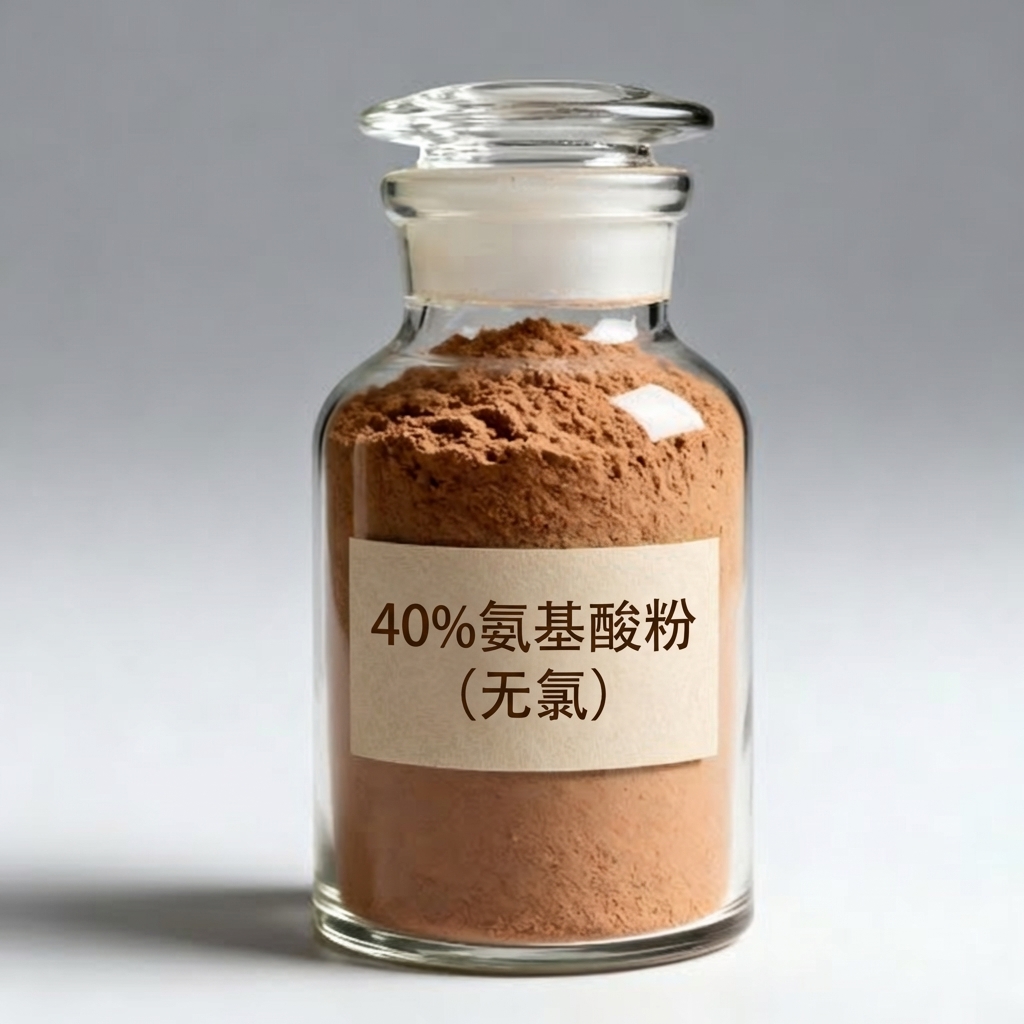
Technical specifications
Chemical and physical properties
| Serial Number | Indicator name | Specification Requirements |
|---|---|---|
| 1 | Appearance | Yellow fully soluble powder |
| 2 | Total Amino Acid | ≥ 40% |
| 3 | Free Amino Acid | ≥ 20% |
| 4 | Chloride Ion | ≤ 1% |
| 5 | Water solubility (Water Solubility). | Fully soluble, no sediment |
| 6 | Flowability | Good flowability, non-caking |
| 7 | pH (1% aqueous solution) | 4 — 6 |
Product description
Product overview
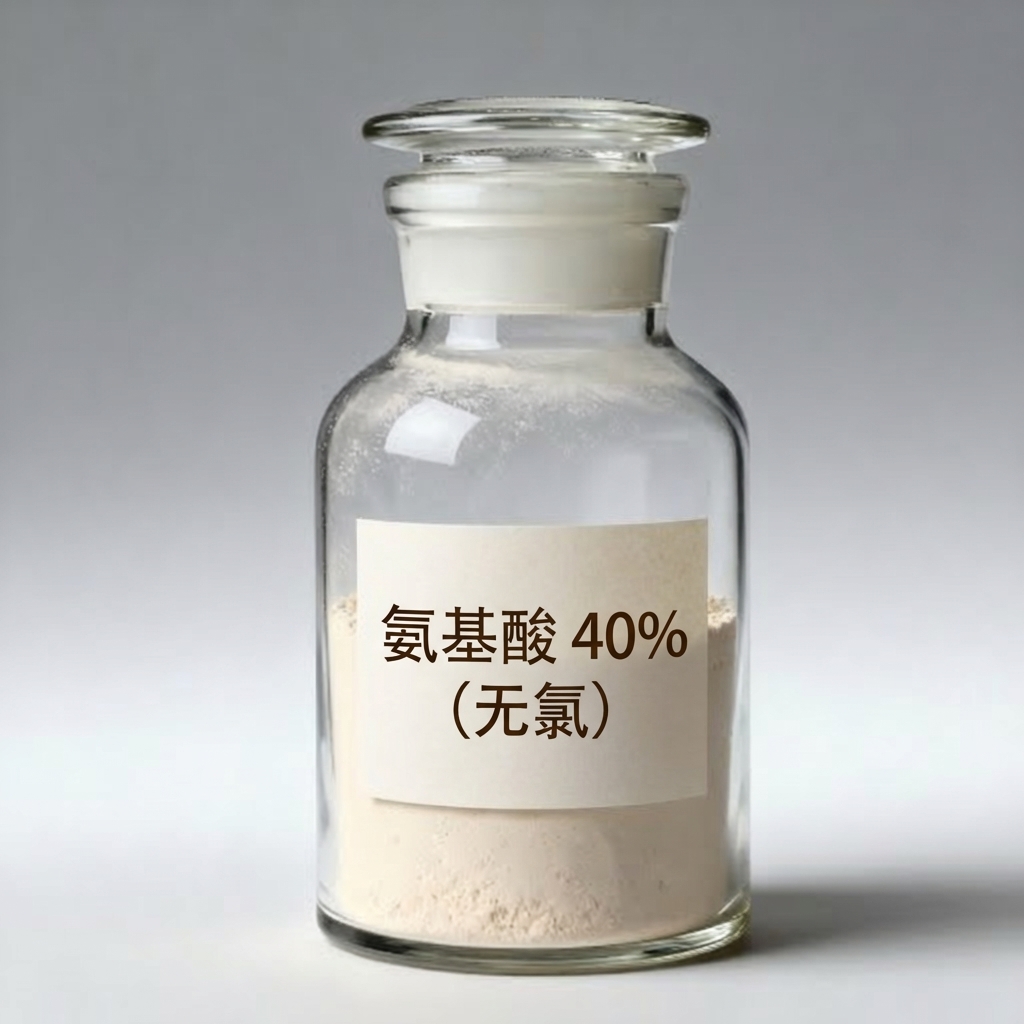
Amino Acid Powder 40% (Low Chloride) (Amino Acid 40% Low Chloride Powder) is a standard low-chloride amino acid powder supplement. The product is a fully soluble yellow powder with total amino acids ≥40%, free amino acids ≥20%, chloride ions ≤1%, pH 4-6. Made with advanced enzymatic technology, with a complete amino acid profile, good water solubility, and excellent flowability, it is a quality raw material for producing water-soluble, foliar, and liquid fertilizers.
Key Advantages
- Standard FormulationTotal amino acids ≥40%, free amino acids ≥20%, meeting the needs of most water-soluble fertilizer production.
- Low-chloride formulaChloride ion content ≤1%, suitable for chlorine-sensitive crops and premium water-soluble fertilizer production.
- Fully soluble, good flowabilityYellow fully soluble powder, dissolves quickly, no residue, good flowability, does not cake.
- Slightly Acidic FormulapH 4-6, good compatibility with most fertilizers and pesticides, high combinability.
- Enzymatic technologyProduced by enzymatic hydrolysis, contains a full spectrum of amino acids with high biological activity.
- High ProfitabilityStandard formula, moderate price — ideal choice for mass production of water-soluble fertilizers.
Comparison of Product Advantages
| Characteristics | Description | Area of application |
|---|---|---|
| Standard Formulation | Total amino acid content ≥40%, free amino acids ≥20%, meeting requirements for most water-soluble fertilizers. | Production of general-purpose water-soluble fertilizers, used in large volumes. |
| Low-chloride formula | Chloride content ≤1%, suitable for chlorine-sensitive crops | Potato, tobacco, tea, grape and other crops |
| Fully soluble, good flowability | Rapid dissolution, no sediment, excellent flowability, non-caking | For use in drip irrigation, foliar application, and fertigation |
| High Profitability | Standard formula, moderate price | Large-scale production of water-soluble fertilizers |
Area of application
Application recommendations
Drip Irrigation (Recommended)
Fully water-soluble formula, ideal for protected cultivation and precision agriculture; amino acids are absorbed directly by plants.
- Concentration: 0.5 – 2 g/L irrigation water
- Application rate: 2—5 kg/mu/application
- Frequency: every 10–15 days
- Note: Can be used together with water-soluble macronutrient fertilizers.
Foliar Feeding
Quickly replenishes amino acids, stimulates plant growth, enhances stress resistance, suitable for foliar feeding of various crops.
- Dilution ratio: 1:800 – 1:1500
- Application rate: 30 — 60 L/mu
- Time: morning or evening, avoid high temperatures
- Note: during active growth, it is best to carry out 2-3 sequential sprays for optimal effect.
Application with irrigation water
Applied with irrigation water, suitable for top-dressing fruit trees, vegetables, and other agricultural crops with amino acids.
- Dosage: 5–10 kg/mu/application
- Dilution ratio: 1:100–1:200
- Timing: key crop growth stages
- Note: better to apply more frequently in small amounts
Raw material for water-soluble fertilizers
Used as an amino acid source combined with macronutrient water-soluble fertilizers or for standalone preparation of amino acid water-soluble fertilizers.
- Use directly as raw material
- Addition ratio: 5–20%
- Suitable for fertigation, drip irrigation, and foliar sprays
- Can be applied together with micro-elements
Suitable crops and recommended dosages
| Crop Type | Typical crops | Drip irrigation rate | Application rate for foliar feeding | Application period |
|---|---|---|---|---|
| Fruit Trees | Apples, pears, peaches, grapes, citrus | 3 – 5 kg/mu | 800–1500 times | Germination, flowering, fruit development stages |
| Vegetables | Tomatoes, cucumbers, peppers, eggplants | 2 – 4 kg/mu | 800–1200 times | Seedling stage, flowering stage, fruiting stage |
| Tuber crops | Potato, sweet potato, sugar beet | 3 – 5 kg/mu | 800–1500 times | Germination, tuber formation, and tuber bulking stages |
| Tobacco | Virginia, Burley | 2 – 4 kg/mu | 800–1200 times | After transplanting and during the growing season |
| Tea | Green tea, black tea | 2 – 3 kg/mu | 1000 – 1500 times | Post-harvest pruning period |
- Store in a cool, dry place, avoid direct sunlight; use opened packaging as soon as possible.
- The product is slightly acidic (pH 4–6); when mixing with alkaline substances, preliminary testing is required.
- Compatible with most fertilizers and pesticides, but it is recommended to perform a compatibility test on a small area before use.
- For foliar application, it is recommended to conduct a preliminary test on a small area to rule out phytotoxicity before large-scale use.
- It is recommended to filter the solution before drip irrigation to avoid clogging of emitters.
Frequently asked questions
The difference lies in the form of existence and the method of amino acid absorption:
- Free amino acidsExist as individual molecules; plant roots or leaves can absorb and utilize them directly without a breakdown process, providing high absorption rate.
- Total amino acidsIncludes free amino acids as well as bound forms such as peptides and proteins. Plants must first break them down into free amino acids for uptake.
- Features of this productTotal amino acids ≥40%, free amino acids ≥20%, free form ratio about 50%, meeting the needs of most water-soluble fertilizer manufacturers.
Main reason for choosing low-chloride amino acid products:
- Chlorine-sensitive cropsCrops such as potatoes, sugarcane, tobacco, grapes, citrus, and tea are sensitive to chloride ions; excess chlorine affects quality and taste.
- Salinity ControlUsing low-chloride products reduces salt accumulation in saline or alkaline soils.
- Food SafetyReduction of chloride ion content in agricultural products, improving product quality and export competitiveness.
The timing of amino acid application should be determined according to the crop growth cycle and needs:
- Emergence PhaseStimulates root system development and seedling growth, increases stress resistance.
- Active growth periodReplenishes nutrients, stimulates stem and leaf growth
- Flowering and Fruiting PeriodImproves flowering quality, promotes fruit development
- Stress periodApplication before or after stress conditions (drought, low/high temperatures) increases plant resistance.
- Post-harvestRapidly replenishes tree nutrition, restores tree health
It is recommended to apply before the peak of crop nutrient demand for best results.
Store in original packaging, in a dry, cool, well-ventilated place. Shelf Life:24 monthsStorage Precautions:
- Keep out of direct sunlight and humid environments.
- Avoid contact with sharp objects to prevent damage to packaging
- Avoid storage with strong oxidizers, strong acids, and strong alkalis.
Once the package is opened, use the product as soon as possible; any unused product must be sealed tightly for storage.
Products are exported to Southeast Asia, the Middle East, Europe, and other regions; export documents provided include:
- Commercial Invoice
- Packing List
- Certificate of Origin (CO)
- Phytosanitary Certificate
- SDS/MSDS (Multilingual Version)
- Certificate of Analysis (COA)
Send Inquiry
Please fill in the following information; our commercial team will contact you promptly.Within 2 working daysWe will reply to you.
Products of One Series
More options of amino acid powders to meet the needs of various crops and soils.