中文
中文 English
 Russian
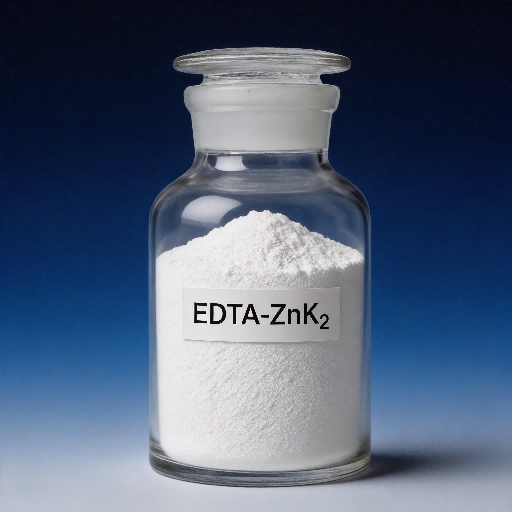
Technical specifications
Chemical and Physical Specifications (Agricultural Grade)
| Number | Indicator name | Specification Requirements |
|---|---|---|
| 1 | Product Name | EDTA potassium-zinc salt |
| 2 | Chemical Formula | Not applicable |
| 3 | Molecular weight | Not applicable |
| 4 | CAS No. | Not applicable |
| 5 | Zinc Chelate (Zn) | 14.0% - 15.0% |
| 6 | pH (1% solution) | 4.0 - 8.0 |
| 7 | Appearance | White Powder |
| 8 | Packaging Specification | kg bags or as per customer request |
| 9 | Storage | Store in a sealed, dry, well-ventilated, cool warehouse. |
Physical Properties
| Position | Description |
|---|---|
| Appearance | White Powder, Uniform Color |
| Odor | Odorless |
| Water Solubility | Fully water-soluble, dissolves quickly, no sediment |
| Granulometric composition | Residue on 80 mesh sieve ≤5% |
| pH (1% solution) | 4.0 - 8.0 |
Product description
Zinc dipotassium ethylenediaminetetraacetate (EDTA ZnK2) — a highly effective zinc fertilizer in EDTA chelate form. The product is a white powder with chelated zinc content 14.0%-15.0% and pH 4.0-8.0. Due to EDTA chelation technology, zinc is in the form of EDTA chelate, ensuring direct absorption and uptake by crops with much higher efficiency compared to conventional inorganic zinc fertilizers.
Product Features
- High chelated zinc content: Zn 14.0%-15.0%
- EDTA chelation technologyStable, poor soil fixation
- Potassium-containing formulaSupplementary Potassium Application
- Fully water-solubleDissolves quickly, no sediment or residues
- Stable pH1% Solution pH 4.0-8.0
Area of application
Agricultural nutrients, fertilizers
Application recommendations
Drip Irrigation (Recommended)
Fully water-soluble formula, especially suitable for protected cultivation and precision agriculture. EDTA-chelated zinc can be directly absorbed by crops.
- Concentration: 0.5 – 2 g/L irrigation water
- Application rate: 0.5–2 kg/mu/application
- Frequency: every 10–15 days
Foliar Feeding
Rapidly replenishes zinc deficiency and eliminates its symptoms; especially suitable for fruit trees and vegetables.
- Dilution ratio: 1:1000 – 1:2000
- Application rate: 30 — 60 L/mu
- Time: morning or evening, avoid high temperatures
Application with irrigation water
Applied with irrigation water (fertigation), suitable for replenishing zinc in fruit trees, vegetables, and other cash crops.
- Dosage: 1–3 kg/mu/application
- Dilution ratio: 1:100 – 1:200
- Timing: Critical Growth Stages of Crop
Complex water-soluble fertilizer
Used as a zinc source in combination with water-soluble macronutrient fertilizers for balanced nutrition.
- Used together with water-soluble macronutrient fertilizers
- Addition ratio: 1 — 5%
- Suitable for melons, vegetables, fruit trees
Suitable crops and recommended dosages
| Crop Type | Typical crops | Rate for drip irrigation | Application rate for foliar feeding | Application period |
|---|---|---|---|---|
| Fruit Trees | Apple, pear, peach, grape, citrus | 1 – 2 kg/mu | 1000 — 2000 times | Period of germination, flowering and fruit set formation |
| Vegetables | Tomatoes, cucumbers, peppers, eggplants, leafy vegetables | 0.5 – 1.5 kg/mu | 1000 – 1500 times | Stage of Emergence, Flowering, and Fruiting |
| Field Crops | Wheat, corn, rice, soybean | 0.5 – 1 kg/mu | 1000 – 1500 times | Tillering stage, stem elongation stage |
- Store in a sealed, dry, well-ventilated, cool warehouse.
- For foliar application, it is recommended to first conduct a small-area test to ensure no phytotoxicity before large-scale application.
- Compatible with most fertilizers and pesticides, but a small-area test is recommended before use.
- Before use in drip irrigation, it is recommended to filter the solution to prevent clogging of drippers with impurities.
- Zinc dosage must be controlled to avoid excess and toxicity.
Frequently asked questions
Typical symptoms of zinc deficiency in plants include:
- Small LeavesNew leaves become smaller, rosette formation observed
- Albino SeedlingChlorosis and whitening between leaf veins
- Growth RetardationPlants are stunted, with shortened internodes
- Fruit development disordersFruits Shrivel, Quality Declines
Commonly found in high pH soils (calcareous soils), soils with low organic matter, or fields with intensive liming.
The main difference lies in the chelated form and nutrient composition:
- Ordinary zinc fertilizerExists as inorganic salts (e.g., zinc sulfate), low absorption rate.
- EDTA ZnK2Zinc is in the form of EDTA chelate, "encapsulated" within the EDTA molecule, ensuring good stability, resistance to fixation in soil, and direct uptake and utilization by crops.
- Potassium-containing formulaSimultaneously replenishes potassium, especially suitable for fruit development stage and potassium-demanding crops.
Store in a sealed, dry, well-ventilated, and cool warehouse. Shelf life in sealed original packaging is24 monthsStorage considerations:
- Keep out of direct sunlight and humid environments.
- Avoid contact with sharp objects to prevent damage to packaging
After opening the package, use as soon as possible; unused product must be stored sealed tightly.
Send Inquiry
Please fill in the following information, our commercial team will contact youWithin 2 working daysWe will respond to you.
Products of the same series
More options for EDTA chelated micronutrient products to meet various crop and soil needs.