 中文
中文 English
 Russian
EDDHA vs EDTA: Choosing Iron Chelates for Fertilizer Supply
For chelated iron fertilizer procurement, EDDHA vs EDTA is primarily a comparison of how the iron chelate performs in the intended root-zone conditions. Fe-EDDHA is generally the stronger candidate for alkaline or calcareous soil; Fe-EDTA can be considered in more acidic or controlled-pH systems. Neither choice should be made from iron percentage alone. Fertilizer blenders need the crop, application route, soil and irrigation-water data before choosing the commercial grade.
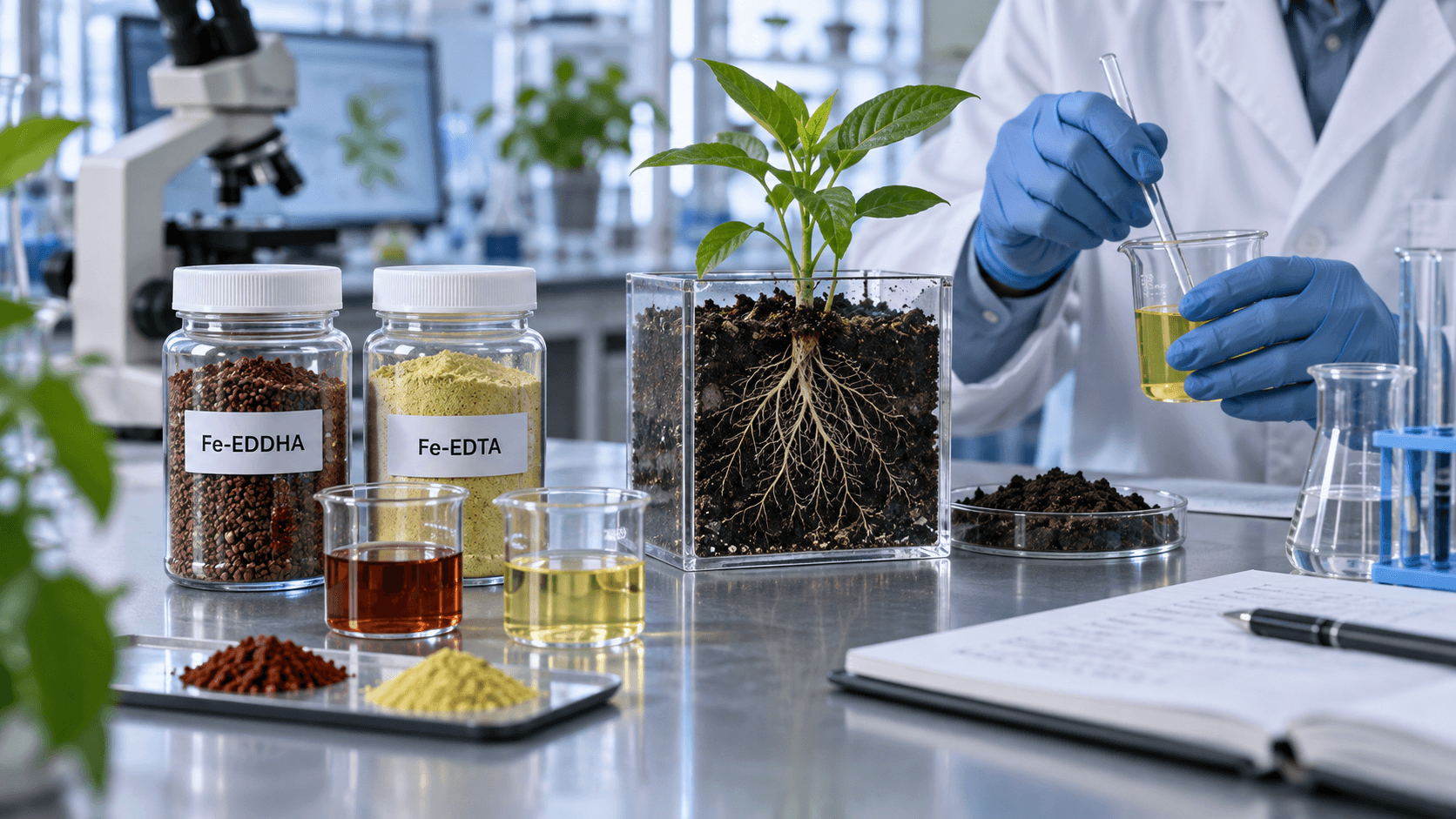
For chelated iron fertilizer procurement, EDDHA vs EDTA is primarily a comparison of how the iron chelate performs in the intended root-zone conditions. Fe-EDDHA is generally the stronger candidate for alkaline or calcareous soil; Fe-EDTA can be considered in more acidic or controlled-pH systems. Neither choice should be made from iron percentage alone. Fertilizer blenders need the crop, application route, soil and irrigation-water data before choosing the commercial grade.
Why chelate stability matters more than iron content
The EDDHA-FeNa-6 specification lists chelated iron at 5.8–6.5%; the EDTA-FeNa specification lists 12.5–13.5%. These different catalogue concentrations affect the amount of product needed to deliver a stated mass of iron, but do not prove which chelate keeps iron available in the intended growing medium. Compare chelated-iron results on the same test and reporting basis before comparing delivered cost.
EDDHA vs EDTA vs DTPA in field conditions
UF/IFAS guidance explains that iron-chelate effectiveness depends on growing-medium pH and identifies EDDHA as more stable under alkaline conditions. Use Fe-EDTA where its stability fits the actual application; evaluate Fe-DTPA as another candidate when reviewing the pH and formulation window. Do not treat these alternatives as equal-mass replacements or transfer a soil-use recommendation directly to a foliar or concentrated-stock formulation.
Separate application conditions from laboratory specifications. The EDDHA product's pH of 7.0–9.0 is for a 1% aqueous solution, not a guaranteed soil-pH range. Ask for application evidence relevant to the proposed crop and route, and agree a trial rather than inferring field performance from the product solution pH.
Practical decision checklist for blenders
- Identify target soil pH and irrigation water alkalinity.
- Confirm application method: fertigation, foliar feeding, or dry blending.
- Compare chelate stability under those conditions, not total iron alone.
- Request ortho isomer value for EDDHA grades and COA for each batch.
- Evaluate solubility and residue in a small-batch dissolution test.
- Confirm compatibility with existing NPK and micronutrient blends.
The EDDHA catalogue reports an ortho value range of 1.2–4.8%. It does not establish that every offered grade has the same isomer profile. Request the precise parameter definition, reporting basis, test method and batch result for the grade being quoted. Compare like-for-like ortho-ortho iron data where available; do not assume that the catalogue percentage means a fraction of all EDDHA molecules or label every grade high-ortho.
Use the intended water source and fertilizer blend in dissolution and compatibility trials. Record concentration, mixing sequence, water temperature, time to dissolve and any sediment. Check the concentrate and the intended use dilution over an agreed holding period. For dry blends, include segregation and physical handling in the trial. A clear beaker immediately after mixing is not evidence of field efficacy or long-term stock-solution compatibility.
What to request in an RFQ for iron chelates
- Crop, application route, growing-medium pH and irrigation-water analysis.
- Existing chelate and blend composition, including concentrate and use-dilution conditions.
- Required chelated-iron content and, for EDDHA, the defined isomer parameter and analytical basis.
- Dissolution and compatibility acceptance criteria; proposed sample and trial plan.
- First-order and annual quantities, packaging, destination and required TDS/SDS and batch COA.
Request a specification-matched quotation
Send MOS the application data and the current specification through the EDDHA-FeNa-6 product page. Identify whether EDTA or DTPA is the benchmark, and request comparable grade documents, samples and a quotation for the intended annual demand. Keep application rates subject to the approved crop-specific program rather than extrapolating from the concentration comparison.
FAQ
Is EDDHA always better than EDTA?
No. Fe-EDDHA is a stronger candidate in alkaline soil, while Fe-EDTA may suit more acidic or controlled-pH conditions. Application method and the actual formulation still require evaluation.
Can the two grades be replaced kilogram for kilogram?
No. Compare chelated-iron concentration first, then confirm stability and compatibility in the intended application. Equal iron input does not establish equal field performance.
Does pH 7–9 on the EDDHA specification describe the soil range?
No. The listed value is the pH of a 1% aqueous solution. It must not be used as a guaranteed field operating range.
What should an EDDHA isomer document specify?
The parameter being measured, its reporting basis, method, acceptance limit and batch result. Clarify the meaning of an ortho value before comparing supplier offers.