 中文
 English
 Russian

Jones Act Waiver Extended: What Fertilizer Buyers Must Check
CBP extends the waiver window from November 16. Check the loading deadline, listed fertilizer codes and individual-voyage decision before planning transport.

The United States has extended a Jones Act waiver for U.S. coastwise shipping for another 90 days, but a fertilizer appearing on the attached product list is not permission to send it on any foreign-flag vessel. The practical question remains whether the proposed voyage has been authorized and whether its loading meets the applicable deadline.
In guidance issued on 13 November 2026, U.S. Customs and Border Protection (CBP) announced the third extension of the waiver originally dated 17 March. The notice matters to fertilizer traders and logistics teams evaluating movements within the scope of that waiver. It does not establish a new MOS shipping service or a general entitlement to import fertilizer into the United States.
Keep the announcement, start and loading dates separate
CBP published the notice on 13 November at 4:29 p.m. EST. The extended period starts on 16 November 2026 at 12:00 a.m. Eastern Time. Covered products must be loaded aboard the relevant vessel before the deadline expires at 11:59 p.m. Eastern Time on 14 February 2027.
That last condition concerns loading. A purchase order, booking confirmation or charterparty date is not, by itself, evidence that cargo was loaded before the deadline. Nor should the stated loading cutoff be presented as an arrival deadline. For a real movement, the parties need to reconcile the agreed schedule with loading records and the conditions of the voyage authorization.
The times above retain the time zone used in the notice. A reader translating the dates into a local operations calendar should keep the original Eastern Time reference alongside the conversion.
A listed fertilizer code is only the first screening step
The attachment is expressly a list of potentially covered products. It includes diammonium phosphate, or DAP, under HTS 3105300000, and monoammonium phosphate, or MAP, under HTS 3105400010. The exact product description and code matter; a broad label such as “phosphate fertilizer” is not a substitute for checking the shipment's classification.
Our comparison of the November 16 attachment with the earlier August 17 list found the same 228 distinct codes, with no added or removed codes and no changed descriptions. On that comparison, the new notice extends the time window rather than demonstrating an expansion of the commodity list. This is an editorial comparison of the two published files, not a classification ruling for a particular cargo.
The table below separates documents that are easily confused when a supply offer is discussed.
| Evidence | What it can establish | What it does not establish alone |
|---|---|---|
| Matching description and HTS code in the attachment | The cargo can be screened against the listed product scope | Authorization for a particular vessel or voyage |
| Individual-voyage decision following the vessel-availability process | Whether the proposed foreign-flag movement is authorized | Completion of loading or satisfaction of every other applicable requirement |
| Records showing loading aboard the relevant vessel | The actual loading event and its timing | Permission to replace a vessel, route or cargo outside the approved conditions |
| Commercial offer and delivery schedule | The seller's proposed terms | Regulatory approval, a guaranteed freight reduction or assured delivery |
The vessel-availability process still applies to each voyage
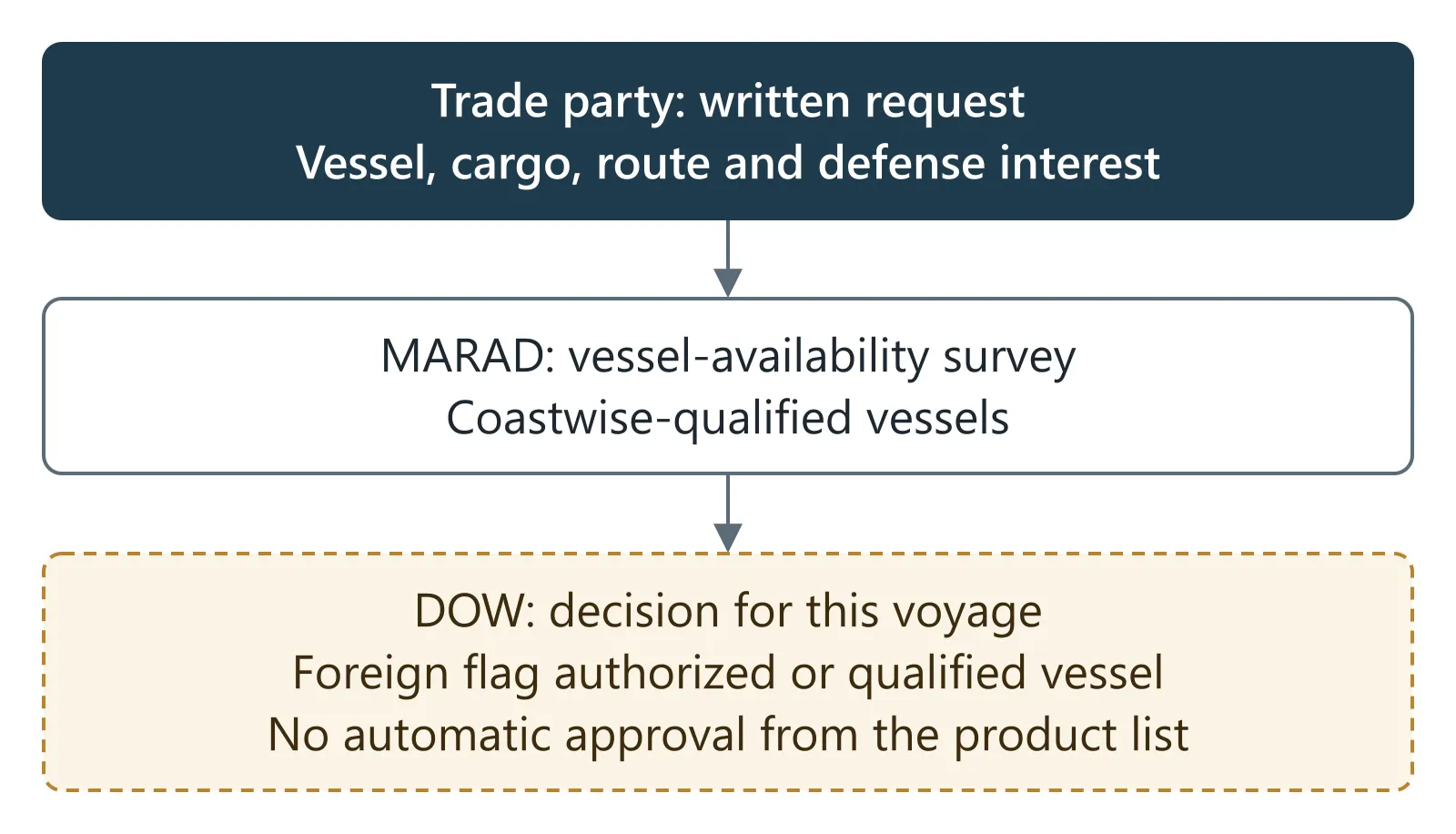
Before initiating a voyage, the notice requires a written vessel-availability request to the Department of War (DOW) and the Maritime Administration (MARAD), with CBP copied for situational awareness. It calls for vessel identity and flag, owner and operator details, the carrier, ports and dates, cargo description and relevant codes, shipment quantity and frequency, and an explanation of the national-defense interest. Special stowage requirements and charterparty information may also be required.
MARAD then surveys coastwise-qualified vessel availability. DOW uses the survey result to determine whether the waiver applies to the individual proposed voyage and tells the requesting party and agencies whether a foreign-flag vessel is authorized or a coastwise-qualified vessel is available to conduct the movement.
The notice's 24-hour reference is the normal response window for coastwise-qualified vessels answering MARAD's survey, unless MARAD specifies otherwise. It is not a promise that an applicant will obtain approval within 24 hours. A logistics plan should not turn that survey deadline into an assumed clearance time.
Authorization is followed by separate reporting steps
For an authorized foreign-flag movement, CBP also requires notification with the vessel identity, commodity and HTS code, carrier, departure and arrival ports and dates, and a PDF of CBP Form 1302. The initial request and this reporting step serve different purposes.
The guidance additionally identifies a post-voyage report to MARAD under 46 U.S.C. 501(c), due no later than 10 days after the voyage concludes. It names the vessel owner or operator and the requester, when the requester is a different party, as the reporting parties. Keep responsibility for that report visible in the shipment file rather than treating authorization as the final administrative action.
For operational submissions, use the current agency instructions linked above. This article explains the distinctions in that notice; it does not determine eligibility for an individual shipment.
What changes for a fertilizer procurement decision?
The extension creates a further period in which a qualifying, individually authorized movement may be arranged. The notice provides no freight-rate series, available tonnage or completed-shipment data from which to calculate a price or delivery improvement. Those remain separate commercial questions.
A useful supplier or carrier discussion therefore asks three things: which listed description and code fit the cargo; what written decision covers the actual vessel and voyage; and how the loading schedule will be evidenced against the cutoff. Keep the product specification, batch quality and agreed delivery terms in the same commercial review, without confusing them with the waiver decision.
This U.S. coastal-shipping measure is also distinct from the Russian fertilizer export-quota rules. A permission in one jurisdiction does not answer the other jurisdiction's requirements. Neither the CBP notice nor this analysis establishes sanctions clearance, an import approval or a MOS role in a particular shipment.