中文
中文 English
 Russian
Technical specifications
Basic Chemical Information
| Serial Number | Indicator name | Specification Requirements |
|---|---|---|
| 1 | Main content (calculated as KH₂PO₄) | ≥ 98.0% |
| 2 | Potassium oxide (K₂O) | ≥ 20% |
| 3 | Phosphorus(V) oxide (P₂O₅) | ≥ 60% |
| 4 | Moisture (H₂O) | ≤ 0.2% |
| 5 | pH (1% aqueous solution) | 1.8 — 2.2 |
| 6 | Water-insoluble substances | ≤ 0.1% |
| 7 | Chlorides (as Cl) | ≤ 0.009% |
| 8 | Arsenic (as As) | ≤ 0.0005% |
| 9 | Heavy metals (as Pb) | ≤ 0.005% |
Physical Properties
| Project | Description |
|---|---|
| Appearance | White or Colorless Crystal |
| Water Solubility | Easily soluble in water, insoluble in organic solvents |
| Relative density | 2.338 |
| Melting Point | 252.6℃ |
| pH (1% aqueous solution) | 1.8–2.2, highly acidic environment |
| Heat resistance | Low thermal stability, easily decomposes upon heating |
Chemical Properties
| Project | Description |
|---|---|
| Chemical Formula | KH₅(PO₄)₂ |
| Molecular weight | 234 |
| CAS No. | 14887-42-4 |
| Aqueous solution properties | Aqueous solution is strongly acidic. |
| Solubility | Easily soluble in water, insoluble in organic solvents |
Product description
Product overview
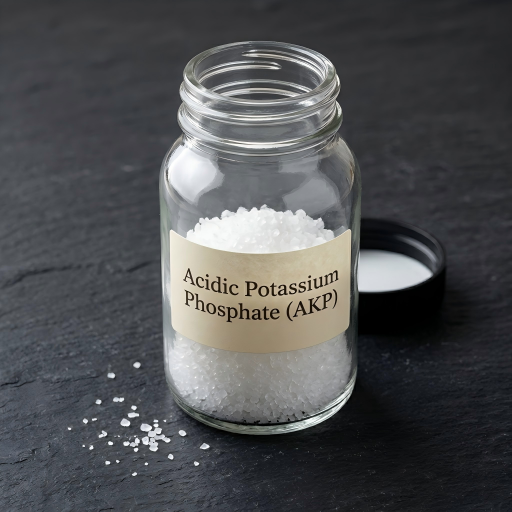
Acidic Potassium Phosphate (AKP) is a new high-efficiency water-soluble fertilizer. Appearance: white or colorless crystal, easily soluble in water, insoluble in organic solvents. Chemical formula KH₅(PO₄)₂, molecular weight 234, relative density 2.338, melting point 252.6°C. Aqueous solution is strongly acidic (pH 1.8-2.2).
Key Advantages
- High phosphorus and potassium contentContains P₂O₅ ≥60% and K₂O ≥20%, providing crops with sufficient phosphorus and potassium nutrition.
- Strongly Acidic PropertiesThe aqueous solution is strongly acidic, particularly suitable for alkaline soil remediation.
- Anti-settling advantageIdeal for use in regions with hard water rich in calcium and magnesium ions, preventing precipitate formation.
- For drip irrigationFully water-soluble, no sediment, suitable for various drip and sprinkler irrigation systems
- High purityMain content ≥98%, low impurity content, safe to use
- Rapidly dissolves in waterEasily soluble in water, dissolves quickly, convenient to use
Main Application
As a new fertilizer, suitable for alkaline soils, especially for drip irrigation in areas with hard water containing high levels of calcium and magnesium ions.
Application recommendations
Drip irrigation application (recommended)
Fully water-soluble formula, especially suitable for protected cultivation and precision agriculture, particularly in regions with alkaline soils and hard water.
- Concentration: 1–3 g/L of irrigation water
- Application rate: 3—8 kg/mu/application
- Frequency: every 7–15 days
- Note: can be used together with nitrogen fertilizers; avoid simultaneous mixing with calcium and magnesium fertilizers.
Foliar Feeding
Quickly replenishes phosphorus and potassium nutrition, stimulates plant growth, especially suitable for the peak demand period of crops for phosphorus and potassium.
- Dilution ratio: 1:500 – 1:1000
- Application rate: 30 — 60 L/mu
- Time: morning or evening, avoiding high temperature
- Note: Best results achieved during flowering and fruit development stages.
Application with irrigation water
Applied with irrigation water, suitable for phosphorus and potassium top-dressing of fruit trees, vegetables, and other cash crops.
- Application Rate: 5 – 10 kg/mu/application
- Dilution factor: 1:100–1:200
- Timing: key crop growth stages
- Note: It is better to apply in small doses but more frequently
Mixing water-soluble fertilizers
Used as a source of high phosphorus and potassium in combination with nitrogen fertilizers for balanced nutrition.
- Best effect when used together with nitrogen fertilizers
- Addition dosage: 5–15%
- Suitable for melons, vegetables, fruit trees
- Can be used alone or in combination with other water-soluble fertilizers.
Suitable crops and recommended dosages
| Crop Type | Typical crops | Application rate for drip irrigation | Application Rate for Foliar Spray | Application period |
|---|---|---|---|---|
| Fruit Trees | Apples, pears, peaches, grapes, citrus | 5 – 8 kg/mu | 800–1200 times | Flowering period, young fruit formation, fruit filling |
| Vegetable Crops | Tomatoes, cucumbers, peppers, eggplants | 3 – 6 kg/mu | 800–1000 times | Seedling stage, flowering stage, fruiting stage |
| Cucurbits and fruit crops | Watermelon, melon, strawberry | 3 – 5 kg/mu | 800–1000 times | Vine growth, flowering, and fruit filling period. |
| Oilseed crops | Rapeseed, Peanut, Soybean | 4 – 6 kg/mu | 800–1000 times | Flowering and Podding Period |
| Root and tuber crops | Potatoes, carrots, beets | 4 – 7 kg/mu | 800–1000 times | Tuber Formation and Swelling Stage |
- Store in a cool, dry place, avoid direct sunlight; use opened packaging as soon as possible.
- The aqueous solution is strongly acidic; during use, observe personal protective measures, avoid direct contact with skin and eyes.
- Avoid mixing simultaneously with alkaline fertilizers such as calcium and magnesium to prevent precipitate formation.
- Can be mixed with most acidic fertilizers and pesticides, but a small-scale pre-test is recommended.
- For foliar application, it is recommended to first test on a small area and only use widely after confirming no phytotoxicity.
- Before use in drip irrigation, it is recommended to filter the solution to prevent clogging of drippers with impurities.
- Low thermal stability, easily decomposes upon heating; avoid storage and transport at high temperatures.
Frequently asked questions
The main difference between them lies in chemical properties and applications:
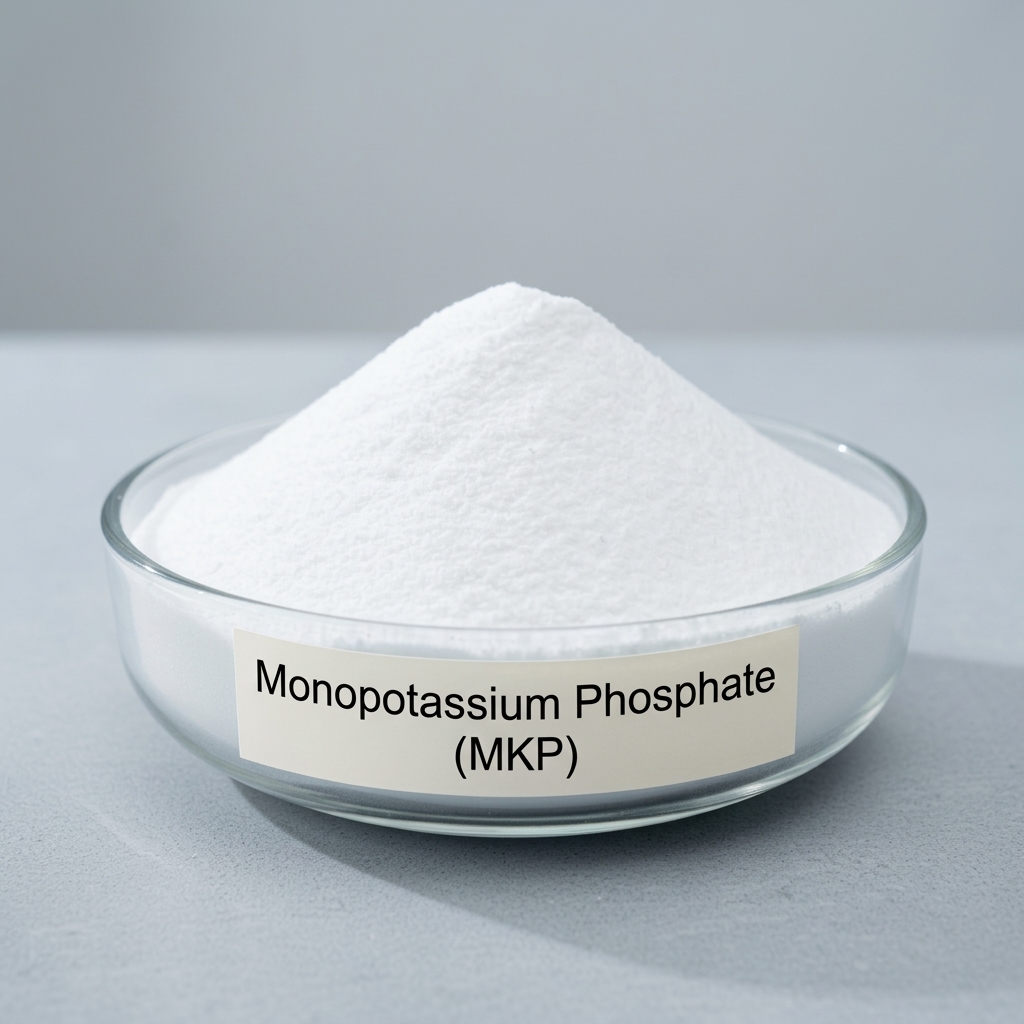
- Various chemical formulasChemical formula of AKP is KH₅(PO₄)₂, chemical formula of MKP is KH₂PO₄.
- AcidityAKF aqueous solution is strongly acidic (pH 1.8-2.2), MKF aqueous solution is weakly acidic (pH 4.3-4.7).
- Sedimentation stabilityIn hard water conditions, AKP is less prone to precipitation with calcium and magnesium ions, whereas MKP readily forms calcium phosphate precipitate in hard water.
- Area of applicationAKP is especially suitable for alkaline soils and hard water regions; MKP is suitable for neutral or acidic soils and soft water regions.
This is mainly due to the strong acidic properties of AKP:
- Alkalinity neutralizationAKP aqueous solution is strongly acidic, effectively neutralizing substances such as calcium carbonate and magnesium carbonate in alkaline soils, reducing soil pH.
- Sedimentation stabilityIn hard water (containing high levels of calcium and magnesium ions), AKF does not readily form precipitates such as calcium phosphate or magnesium phosphate, preventing clogging of drip irrigation systems.
- Improving nutrient availabilityIn alkaline soils, phosphorus is easily fixed as insoluble phosphates; the strong acidity of AKP can dissolve these fixed forms of phosphorus, increasing its availability.
- Improved soil structureLong-term application gradually improves the structure of alkaline soils, promoting the development of the plant root system.
The application period of AKR should be determined according to the crop growth cycle and nutrient uptake characteristics:
- Flower bud differentiation periodStimulates flower bud differentiation, improves flowering quality, and increases fruit set rate.
- Fruit set phaseStimulates cell division and development in young fruits, laying the foundation for fruit enlargement
- Fruit Filling PeriodPromotes rapid fruit enlargement and increases yield
- Maturation PeriodPromotes sugar accumulation in fruits and improves quality
- Root system development periodStimulates root system growth, enhances plant stress resistance.
It is recommended to schedule application timing according to the peak periods of crop phosphorus and potassium demand.
Store in original sealed packaging, in a cool, dry, well-ventilated place. Shelf life:24 monthsPrecautions for storage:
- Avoid direct sunlight and humid environment
- Prevention of package damage upon contact with sharp objects
- Avoid storing together with strong oxidizers and alkalis
- Protect from moisture and water, use immediately after opening the package.
- Caution: low thermal stability, easily decomposes upon heating; avoid storage and transport at high temperatures.
This product is exported to many regions including Southeast Asia, the Middle East, Europe; export documents provided include:
- Commercial Invoice
- Packing List
- Certificate of Origin (CO)
- Phytosanitary Certificate
- SDS/MSDS (Multilingual Version)
- Certificate of Analysis (COA)
Send Inquiry
Please fill in the following information, our commercial team will contact youWithin 2 working daysWe will reply to you.
Products of One Series
More options of water-soluble phosphorus-potassium fertilizers for different crops and soil types.