中文
中文 English
 Russian
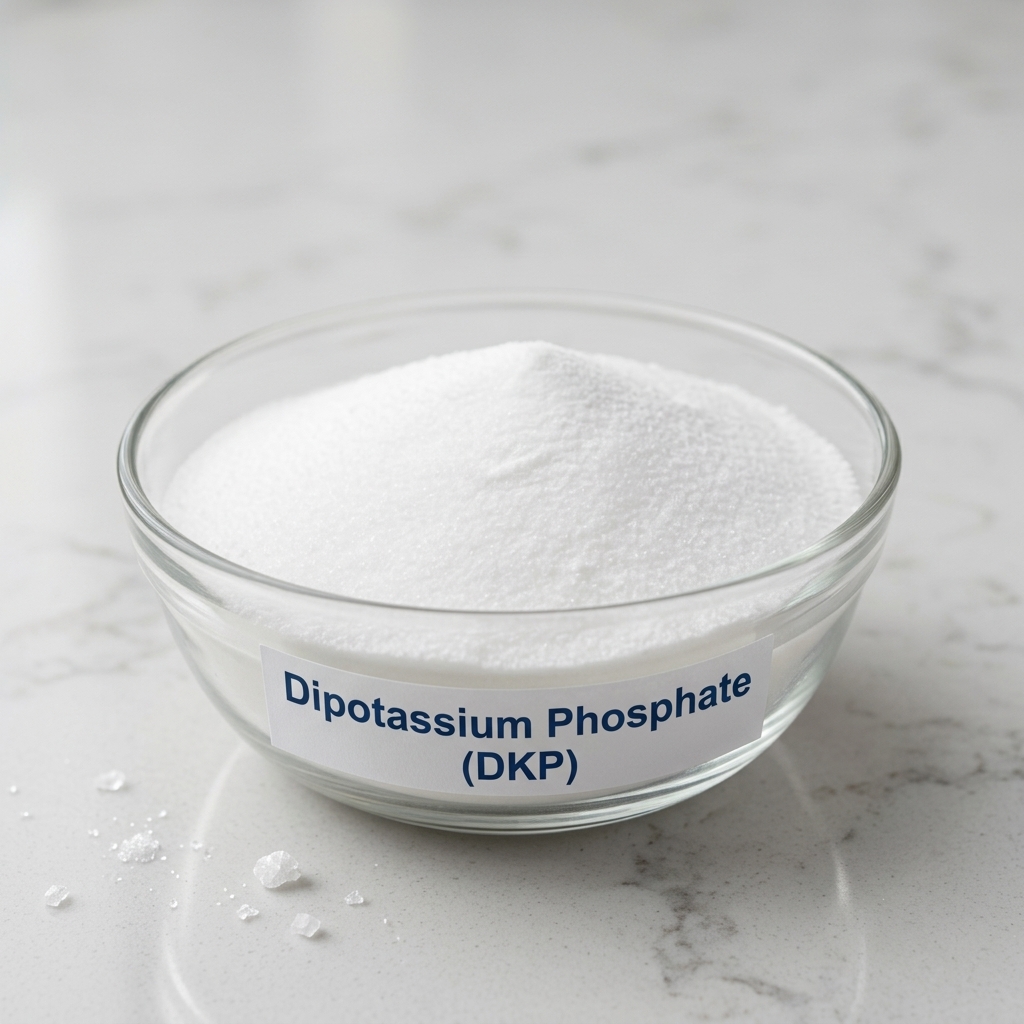
Technical specifications
Basic Information
| Products | Parameters |
|---|---|
| Product Name | Dipotassium Phosphate |
| English name | Dipotassium phosphate (DKP) |
| CAS No. | 7758-11-4 (anhydrous); 16788-57-1 (trihydrate) |
| Chemical Formula | K2HPO4, K2HPO4·3H2O |
| Molecular weight | 174.18 (anhydrous), 228.22 (trihydrate) |
| Appearance | White crystals or amorphous white powder |
| Relative density | 2.338 |
Physical and chemical properties
| Products | Description |
|---|---|
| Appearance | White crystals or amorphous white powder |
| Water soluble | Easily soluble in water, aqueous solution is slightly alkaline |
| Alcohol Soluble | Slightly Soluble in Alcohol |
| Hygroscopicity | Hygroscopic |
| Heat resistance | Self-dissolves at elevated temperatures; at 204°C, intramolecular dehydration converts it into potassium pyrophosphate. |
| pH (1% aqueous solution) | Approx. 9 |
Technical specifications — industrial grade (HG/T4510-2013)
| Indicator name | DKP·3H2O | Anhydrous Substance |
|---|---|---|
| Dipotassium Phosphate (K2HPO4) w/% ≥ | 98 | 98 |
| Phosphorus pentoxide (P₂O₅) content, wt.% ≥ | 30.5 | 40 |
| Potassium oxide (K₂O) mass/% ≥ | 40.5 | 53 |
| Water-insoluble substances, wt. % ≤ | 0.02 | 0.02 |
| Chlorides (as Cl) Mass/% ≤ | 0.05 | 0.05 |
| Iron (Fe), wt% ≤ | 0.003 | 0.003 |
| Arsenic (As), wt% ≤ | 0.01 | 0.01 |
| Heavy metals (as Pb) mass/% ≤ | 0.005 | 0.005 |
| pH (1% aqueous solution) | 9.0 — 9.4 | |
| Loss on drying, wt% ≤ | 22 — 26 | 2 |
Technical specifications - food grade (GB25561-2010)
| Indicator name | DKP·3H2O | Anhydrous Substance |
|---|---|---|
| Dipotassium Phosphate (K2HPO4) w/% ≥ | 98 | 98 |
| Phosphorus pentoxide (P₂O₅) content, wt.% ≥ | 30.5 | 40 |
| Potassium oxide (K₂O) mass/% ≥ | 40.5 | 53 |
| Water-insoluble substances, wt. % ≤ | 0.2 | 0.2 |
| Fluoride (as F) mass % ≤ | 0.001 | 0.001 |
| Arsenic (As), wt% ≤ | 0.0003 | 0.0003 |
| Heavy metals (as Pb) mass/% ≤ | 0.001 | 0.001 |
| Lead (Pb), wt% ≤ | 0.0002 | 0.0002 |
| pH (1% aqueous solution) | 8.6 — 9.4 | |
| Loss on drying, wt% ≤ | 22 — 26 | 2 |
Packaging and Storage
| Products | Description |
|---|---|
| Packaging method | Inner plastic packaging, outer woven bag |
| Packaging | 25 kg/bag, 50 kg/bag, 1000 kg/bag (big bag) |
| Storage Conditions | Store in a dry, well-ventilated place |
| Shelf Life | 24 months (when stored in sealed packaging) |
Product description
Product overview
Dipotassium phosphate (DKP), CAS No: 7758-11-4 (anhydrous); 16788-57-1 (trihydrate), chemical formula K₂HPO₄ (anhydrous) or K₂HPO₄·3H₂O (trihydrate). Molecular weight 174.18 and 228.22, respectively. White crystals or amorphous white powder, easily soluble in water, aqueous solution slightly alkaline, slightly soluble in alcohol, hygroscopic.
Physical and chemical properties
- AppearanceWhite crystalline or amorphous white powder
- Water solubleEasily soluble in water, aqueous solution is slightly alkaline
- Alcohol SolubleSlightly Soluble in Alcohol
- HygroscopicityHygroscopic, self-dissolves at elevated temperature
- Heat resistanceAt 204°C, intramolecular dehydration converts it into potassium pyrophosphate.
- Relative density: 2.338
- pH valueAbout 9 for 1% aqueous solution
Specification Standard
| Grade | Standard | Main Application |
|---|---|---|
| Industrial Grade | HG/T4510-2013 | Preparation of water-soluble fertilizers, boiler water treatment, electroplating additives. |
| Food | GB25561-2010 | Food industry, pharmaceutical nutrient media, feed additives. |
Nutrient Indicators
Application recommendations
Agricultural Production
Used as a raw material for producing high-efficiency water-soluble and compound fertilizers, as well as for manufacturing potassium pyrophosphate.
- Raw materials for water-soluble fertilizers
- Formulation of Complex Mixed Fertilizers
- Raw Material for Potassium Pyrophosphate
Boiler water treatment
Used for boiler water treatment. Used as a buffer agent in chemical analysis, for metal phosphating, and as an additive for electroplating.
- Boiler water treatment agent
- Chemical buffering agents
- Metal phosphating
- Galvanic Additives
Antifreeze application
Used as a corrosion inhibitor in antifreeze, effectively protecting metal equipment.
- Antifreeze-Corrosion Inhibitor
- Metal protection
Fermentation industry
A phosphorus and potassium regulator in the fermentation industry, used for cultivating microorganisms and fungi.
- Phosphorus and potassium regulators
- Microbial cultivation
- Products for mushroom cultivation
Pharmaceutical preparations and culture media
Used in the pharmaceutical industry (as a nutrient medium for penicillin, streptomycin), as a nutrient for antibiotic culture media.
- Penicillin nutrient medium
- Streptomycin culture medium
- Antibiotic cultivation medium
- Nutrient Product
Food industry
In the food industry, it is used as a raw material for alkaline water in flour product preparation, leavening agent, acidity regulator, softening agent, mild alkaline additive for dairy products, and yeast nutrient.
- Alkaline solution for flour products
- Fermentation Agents
- Flavorings and leavening agents
- Alkaline Agent for Dairy Products
- Yeast nutrient supplement
- Additive for milk tea powder
- Feed additive
Other application areas
High-quality raw materials for various industrial applications.
- Talc de-ironing agent
- pH Regulator
- Raw Material for Potassium Pyrophosphate
- Store in a cool, dry, well-ventilated place, avoid direct sunlight and moist environment.
- Do not store together with strong acids, oxidizers, or other substances to avoid chemical reactions.
- The product is hygroscopic; after opening the package, use as soon as possible. Unused product must be stored in a sealed container.
- Keep away from moisture and rain during transportation, avoid package damage.
- When using, it is recommended to wear protective gloves and a mask, avoid direct contact with skin and inhalation of dust.
- At elevated temperatures, autolysis may occur; at 204°C, intramolecular dehydration forms potassium pyrophosphate.
Frequently asked questions
Both are important phosphorus-potassium fertilizers, the main differences are as follows:
- Various chemical formulasDKP is K₂HPO₄ (dipotassium phosphate), MKP is KH₂PO₄ (monopotassium phosphate)
- Various pH valuesAqueous solution of DKP is weakly alkaline (pH about 9), aqueous solution of MKP is acidic (pH about 4.5-5)
- Various Nutrient ContentsK₂O content in DKP is higher (approx. 53%), P₂O₅ content in MKP is higher (approx. 52%).
Both have their own features:
- Nutrient ConcentrationThe anhydrous form has a higher concentration of nutrients (P₂O₅≥40%, K₂O≥53%), while the trihydrate has relatively lower levels (P₂O₅≥30.5%, K₂O≥40.5%).
- StabilityAnhydrous form is more stable, less prone to caking; trihydrate is relatively more hygroscopic.
- PriceTrihydrate has lower production costs and a relatively affordable price.
The main difference lies in impurity content standards and application areas:
- Impurity content limitFood grade imposes stricter requirements on impurities such as arsenic, lead, heavy metals (e.g., As≤0.0003%, Pb≤0.0002%).
- StandardFood grade complies with GB25561-2010, industrial grade complies with HG/T4510-2013
- Area of applicationFood grade is used in the food industry, pharmaceutical cultivation, etc.; industrial grade is used for manufacturing water-soluble fertilizers, industrial water treatment, etc.
Thermal stability characteristics of potassium dihydrogen phosphate:
- HygroscopicityProduct is hygroscopic and may cake under high temperature and humidity.
- AutolysisMay self-dissolve at elevated temperatures
- Molecular dehydrationAt 204°C, intramolecular dehydration occurs to form potassium pyrophosphate (TKPP).
- Storage RecommendationsStore in a cool, dry place, avoid high temperatures
Our dipotassium phosphate products support various packaging options:
- 25 kg/bagInner plastic layer, outer woven bag packaging, suitable for small and medium wholesale purchases.
- 50 kg/bagInner plastic layer, outer woven bag packaging, suitable for standard purchases.
- 1000 kg/bag (big bag)Suitable for bulk purchases, lower cost
Packaging: inner polyethylene bag, outer woven bag. Store in a dry, well-ventilated place.
Send Inquiry
Please fill in the following information, and our commercial team will contact you.Within 2 working daysWe will reply to you.
Products of the same series
More water-soluble phosphorus-potassium fertilizer products to meet various crop and application needs.