中文
中文 English
 Russian
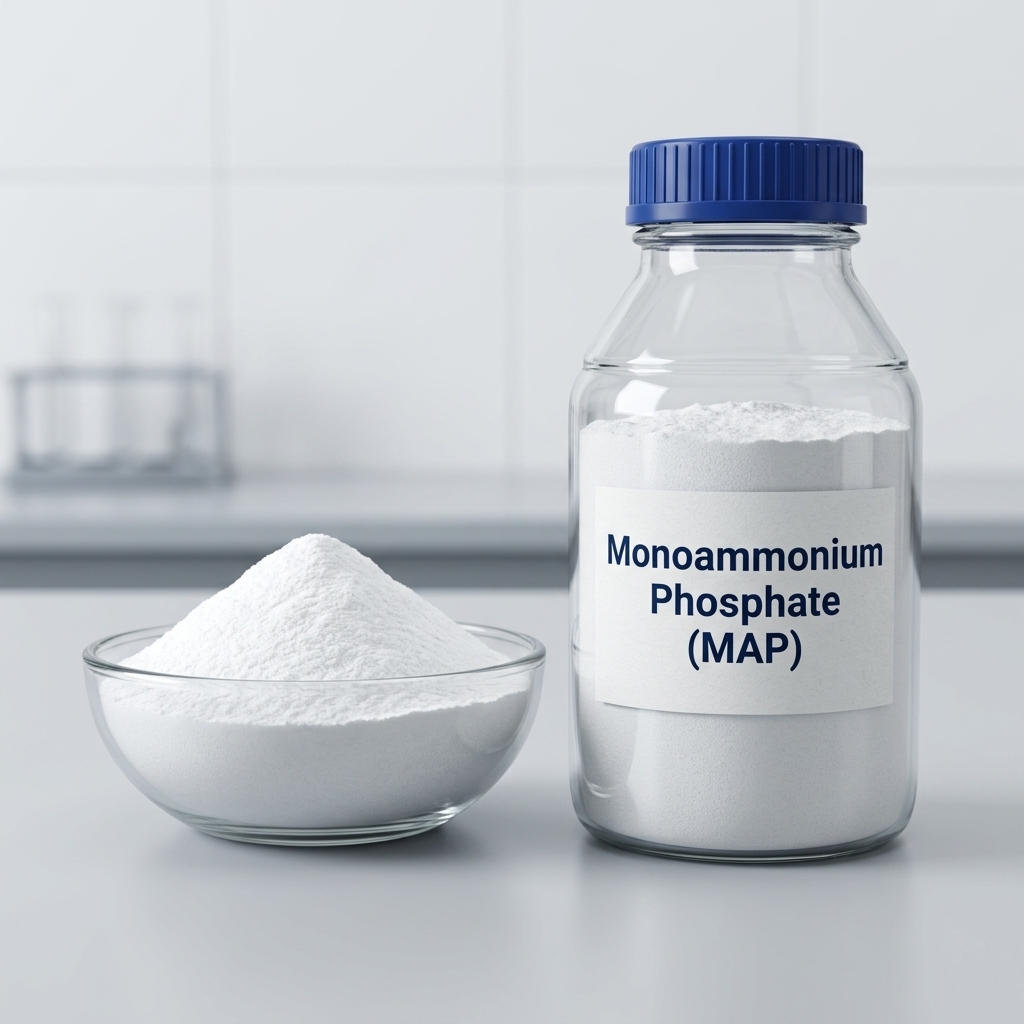
Technical specifications
Basic Information
| Project | Parameters |
|---|---|
| Product Name | Monoammonium phosphate (MAP) |
| English name | Monoammonium Phosphate (MAP) |
| CAS No. | 7722-76-1 |
| Chemical Formula | NH4H2PO4 |
| Molecular weight | 115.0 |
| Appearance | White granular crystals |
| Relative density | 1.0803 |
| Melting Point | 190℃ |
Physical and chemical properties
| Project | Description |
|---|---|
| Appearance | White granular crystals |
| Water Solubility | Easily soluble in water |
| Alcohol Soluble | Slightly Soluble in Alcohol |
| Keto Solubility | Insoluble in Ketones |
| Relative density | 1.0803 |
| Melting Point | 190℃ |
| pH (1% aqueous solution) | 4.0 – 5.0, acidic environment |
Technical specifications — industrial grade (wet process) (HG/T4133-2010)
| Serial Number | Indicator name | Requirements |
|---|---|---|
| 1 | Main content (as NH4H2PO4) % ≥ | 98 |
| 2 | P2O5 % ≥ | 60.5 |
| 3 | Nitrogen (N) % ≥ | 11.5 |
| 4 | pH value of 1% aqueous solution | 4.0 — 5.0 |
| 5 | Water-insoluble substances % ≤ | 0.3 |
| 6 | Moisture (H₂O) % ≤ | 0.5 |
| 7 | Sulfates (as SO4) % ≤ | 1.2 |
Technical specifications — industrial grade (thermal method) (HG/T4133-2010)
| Serial Number | Indicator name | Requirements |
|---|---|---|
| 1 | Main content (as NH4H2PO4) % ≥ | 99 |
| 2 | P2O5 % ≥ | 61 |
| 3 | Nitrogen (N) % ≥ | 12 |
| 4 | pH value of 1% aqueous solution | 4.2 — 4.8 |
| 5 | Water-insoluble substances % ≤ | 0.1 |
| 6 | Moisture (H₂O) % ≤ | 0.5 |
| 7 | Arsenic (as As) % ≤ | 0.005 |
| 8 | Fluoride (as F) % ≤ | 0.02 |
| 9 | Heavy metals (as Pb) % ≤ | 0.005 |
| 10 | Sulfates (as SO4) % ≤ | 0.9 |
Technical specifications — food grade (GB 25569-2010)
| Serial Number | Indicator name | Requirements |
|---|---|---|
| 1 | Main content (as NH4H2PO4) % ≥ | 99 |
| 2 | P2O5 % ≥ | 61 |
| 3 | Nitrogen (N) % ≥ | 12 |
| 4 | pH value of 1% aqueous solution | 4.3 — 5.0 |
| 5 | Water-insoluble substances % ≤ | 0.1 |
| 6 | Moisture (H₂O) % ≤ | 0.2 |
| 7 | Arsenic (as As) % ≤ | 0.0003 |
| 8 | Fluoride (as F) % ≤ | 0.001 |
| 9 | Heavy metals (as Pb) % ≤ | 0.001 |
| 10 | Lead (as Pb) % ≤ | 0.0004 |
Packaging and Storage
| Project | Instruction |
|---|---|
| Packaging method | Inner plastic liner, outer woven bag packaging. |
| Packaging and specifications | 25 kg/bag, 50 kg/bag, 1000 kg/bag (big bag) |
| Storage Conditions | Store in a dry, well-ventilated place |
| Shelf Life | 24 months (when stored under sealed conditions) |
Product description
Product overview
Monoammonium phosphate (MAP), CAS 7722-76-1, chemical formula NH₄H₂PO₄, molecular weight 115.0. White granular crystals, relative density 1.0803, melting point 190°C, easily soluble in water, slightly soluble in alcohol, insoluble in ketones.
Physical and chemical properties
- AppearanceWhite Granular Crystal
- Water SolubilityEasily soluble in water
- Alcohol SolubleSlightly Soluble in Alcohol
- Keto SolubilityInsoluble in Ketones
- Relative density: 1.0803
- Melting Point: 190℃
- pH valuepH of 1% water solution 4.0-5.0, acidic medium.
Specification standards
| Grade | Execution Standard | Main Application |
|---|---|---|
| Industrial Grade (Wet Process) | HG/T4133-2010 | Agricultural fertilizers, flame retardants, industrial applications. |
| Industrial grade (thermal method) | HG/T4133-2010 | High purity requirements, fine chemical industry |
| Food Grade | GB 25569-2010 | Food processing, leavening agent, feed additive |
Nutrient Indicators
Application Recommendations
Agricultural Production
It is a high-efficiency complex nitrogen-phosphorus fertilizer suitable for foliar application, fertigation, drip and sprinkler irrigation, and for preparing compound NPK fertilizers.
- Foliar Feeding
- Fertigation fertilizer
- Fertilizer application via drip and sprinkler irrigation
- Preparation of Compound NPK Fertilizers
Application of flame retardants
Mainly used as a flame retardant for wood, paper, textiles, and also as an additive in fire-resistant coatings.
- Wood flame retardants
- Flame retardants for paper
- Flame retardant treatment for textiles
- Agent for extinguishing match and candle wick
- Flame Retardant Additives for Paints
- Powdered fire extinguishing agent
Industrial application
Dispersant for fiber processing and the dyeing industry, enamel glaze, also used in printing and other fields.
- Dispersant for fiber processing
- Dispersant for the dye industry
- Glaze for enameling
- Printable form
Food industry
Used as a leavening agent, regulator, buffer, etc., conforms to standard GB 25569-2010.
- Fermentation starter
- Regulator
- Buffer Agent
Feed additive
Used as a feed additive for animals, source of phosphorus.
- Phosphorus source for feed
- Nutrition Enhancers
Pharmaceutical manufacturing
Used in the field of pharmaceutical manufacturing.
- Pharmaceutical intermediates
- Raw material for culture media
- Store in a cool, dry, well-ventilated place, avoid direct sunlight and moist environment.
- The product dissolves easily in water; the resulting solution is acidic. When using, pay attention to compatibility with other products.
- Avoid direct mixing with alkaline substances (e.g., lime, sodium hydroxide, etc.) to prevent reaction.
- Keep away from moisture and rain during transportation, avoid package damage.
- When using, it is recommended to wear protective gloves and a mask, avoid direct contact with skin and inhalation of dust.
Frequently asked questions
Both are important ammonium phosphate fertilizers; the main difference lies in:
- Various chemical formulasMAP is NH₄H₂PO₄ (monoammonium phosphate), DAP is (NH₄)₂HPO₄ (diammonium phosphate)
- Various nitrogen contentsMAP contains N≥12%, DAP contains N≥21%, nitrogen content in DAP is higher
- Various phosphorus contentsP₂O₅ content in MAP ≥61%, in DAP ≥53%; phosphorus content is higher in MAP.
- Various pH valuesAqueous MAP solution is more acidic (pH about 4.0-5.0), DAP is slightly alkaline.
Products of the two technologies have their own characteristics:
- Main ContentThermal MAP ≥99%, wet MAP ≥98%, thermal method has higher purity.
- Phosphorus ContentThermal P₂O₅≥61%, Wet P₂O₅≥60.5%.
- Water-insoluble substancesThermal method ≤0.1%, wet method ≤0.3%, thermal method is purer.
- Recommended ChoiceFor general agricultural use, the wet process is recommended as it is cost-effective; for applications requiring high purity, the thermal process is suitable.
Ammonium dihydrogen phosphate has significant advantages as a flame retardant:
- High-efficiency fire protectionWhen heated, it decomposes releasing ammonia and phosphoric acid, forming a protective layer that isolates oxygen.
- Broad ApplicabilityCan be used for flame retardant treatment of wood, paper, textiles, and other materials.
- Special applicationUsed as a damping agent for match heads and candle wicks to prevent re-ignition.
- Powdered fire extinguishing agentis an important component of powder fire extinguishers
The main difference lies in impurity content standards and application areas:
- Impurity content limitFood grade imposes stricter requirements on impurities such as arsenic, lead, heavy metals.
- Moisture RequirementsFood-grade moisture ≤0.2%, stricter than industrial-grade (≤0.5%).
- Execution StandardFood grade conforms to GB 25569-2010, industrial grade conforms to HG/T4133-2010.
- Area of applicationFood grade is used in food processing, fermentation industry, etc.; industrial grade is used in agriculture, as a flame retardant, in feed, etc.
Our monoammonium phosphate is available in various packaging options:
- 25 kg/bagInner plastic, outer woven bag, suitable for small and medium wholesale purchases
- 50 kg/bagInner polyethylene bag, outer woven packaging, suitable for standard procurement.
- 1000 kg/bag (big bag)Suitable for large-volume wholesale purchases, lower cost
Packaging: inner polyethylene bag, outer woven bag. Store in a dry, well-ventilated place.
Send Inquiry
Please fill in the information below, our commercial team will contact you withinWithin 2 working daysWe will reply to you.
Products of One Series
More water-soluble fertilizers with phosphorus and nitrogen for different crops and fertilization needs.