 中文
 English
 Russian

DTPA in Peroxide Pulp Bleaching: Qualify Metal Control Before Comparing Dose
Separate DTPA grade assay, actual pulp and water, residual peroxide and pulp acceptance before comparing chelant dose or ordering a batch.
A DTPA purchase for peroxide pulp bleaching needs more than a concentration and a delivered price. The supplied chelant, the metal burden in the actual pulp and water, and the required bleaching result are three different parts of the decision. A favourable incoming assay does not join them automatically.
The useful question is therefore not simply “how much DTPA should we add?” It is: which supplied grade, evaluated against which pulp and water, produces an acceptable result under the mill’s defined conditions? This guide separates those records before a sample trial or purchase specification is agreed.
A chelating-capacity number is not a bleaching result
A chelating-capacity result expressed as a calcium-carbonate equivalent belongs to its stated analytical method. It can help identify whether a delivered chelant meets an agreed incoming specification. It does not directly measure transition-metal control in a particular pulp, peroxide consumption or the optical properties of the bleached material.
This distinction matters when comparing products described by different salt forms, assay bases or test procedures. Two capacity values are not a sound ranking until the method, units, sample basis and grade identity are comparable. A nominally higher number alone does not demonstrate that the mill can lower the dose or obtain a better pulp result.
| Evidence | What it can establish | What still needs a process trial |
|---|---|---|
| Supplied-grade identity and method-qualified assay | Whether the named material matches the agreed incoming specification | How it behaves with the intended pulp, water and operating conditions |
| Chelating capacity reported on a stated basis | A result for that method and reporting basis | Control of the relevant metals in the actual process |
| Residual peroxide at an agreed sampling point and time | How much peroxide remains under the stated trial conditions | Whether the pulp also meets the required optical and other acceptance criteria |
| Defined pulp acceptance measurements | Whether that trial material meets the selected endpoints | Transfer to another feed, water circuit or operating condition |
The PTS report on chelants in mechanical-pulp bleaching evaluates peroxide and pulp results separately and warns that laboratory results can differ from mill results. It is historical research, not a MOS grade qualification or a universal operating recipe.
Start with the pulp and water that will actually be treated
Transition metals can contribute to peroxide decomposition. But a water-only demonstration does not reproduce every metal source or interaction in a pulp process. Pulp feed, incoming water and recycled process streams may change the conditions presented to a chelant. Recording only the product dose leaves those possible causes of a changed result unresolved.
Begin a qualification record with the pulp identity and condition, the water source and the relevant measured metal information available to the mill. State whether the trial represents a pretreatment or another agreed addition stage. If addition point or separation conditions also change, treat that as a different comparison rather than attributing the whole result to the chelant grade.
The PTS study identifies the type and amount of metals, water-circuit conditions and addition point as important to interpreting results. A related TAPPI public abstract on EDTA and DTPA in TCF bleaching also places chelant use and determination in a process context. Neither source establishes the correct settings for an unidentified mill. Sampling, chemical handling and operating changes belong to the mill’s qualified procedure.
Compare an agreed active basis, then read both endpoints
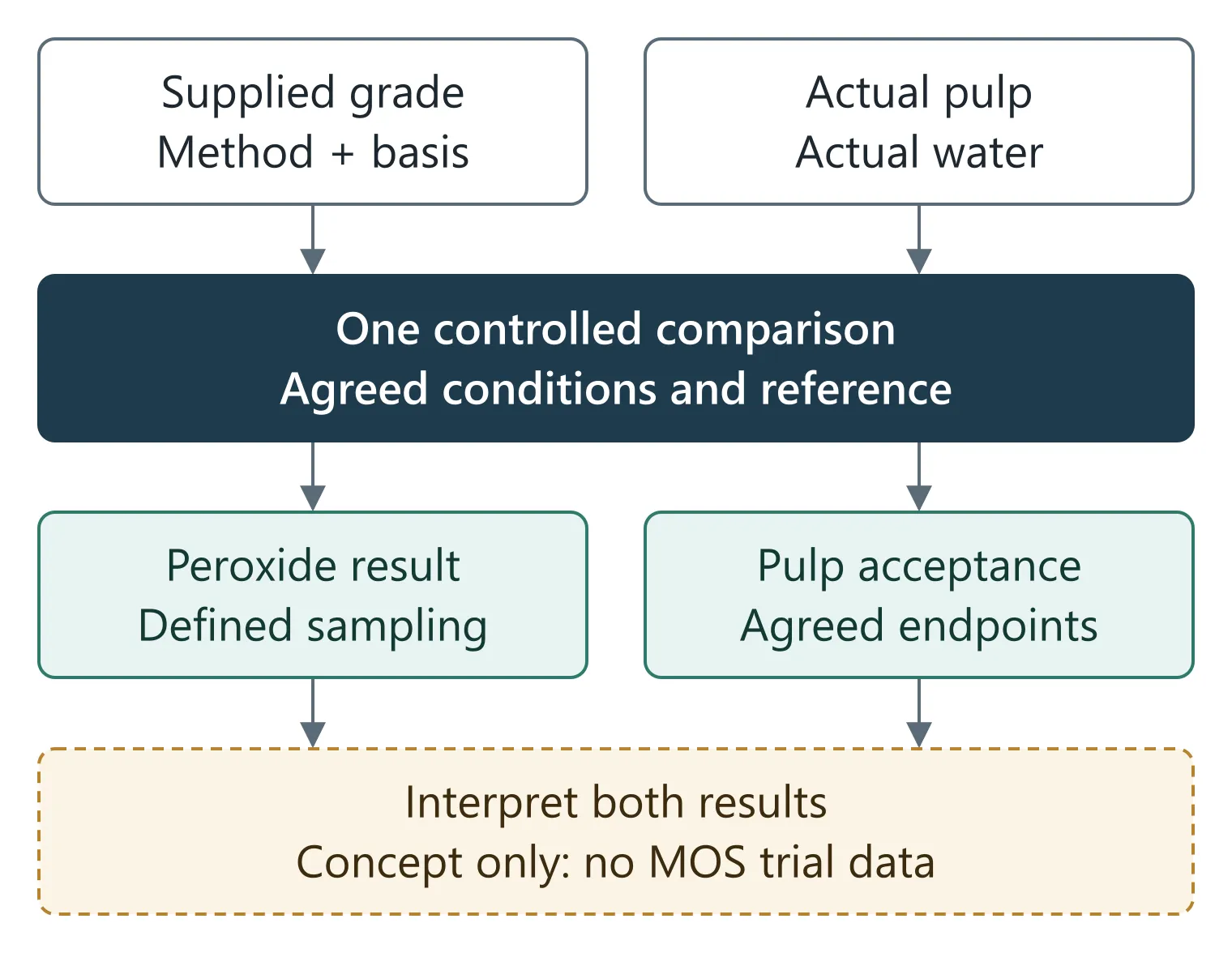
For an initial grade comparison, use the same identified pulp and water and keep the non-test variables agreed: pulp consistency, temperature, time, pH, peroxide charge, other additives, mixing, sampling and analytical methods. These are comparison controls, not recommended operating values. Change the chelant grade or its agreed dose deliberately; do not change several conditions and call the outcome a grade effect.
Confirm what “active basis” means before normalising quantities. A solution concentration, a salt assay and a chelating-capacity equivalent are not interchangeable percentages. The supplier and laboratory should state the method-qualified basis used for the comparison. If that basis cannot be reconciled, pause the ranking rather than calculate a precise-looking substitution ratio.
Read the result as a pair. Less residual peroxide can reflect greater consumption; it does not by itself demonstrate either useful bleaching or a defective chelant. A better optical result alone also does not establish acceptable peroxide use or all required pulp properties. Interpret the agreed peroxide measurement together with the pulp endpoints, the reference condition and the validity of the sampling record.
Stop and repeat or redesign the comparison when the reference is inconsistent, the feed or water changes materially, the analytical basis is unclear, or the agreed pulp acceptance is missed. Do not turn an isolated favourable trial into a universal dose recommendation, environmental claim or assertion that one chelant is always superior.
Write a purchase specification that the trial supports
MOS lists DTPA pentasodium salt solution as an industrial chelant enquiry route. That identity is different from an iron-DTPA fertilizer complex. Keep the exact offered grade, current TDS/SDS and lot-specific assay method attached to the quotation; catalogue information is not a measured result for a delivered batch.
A useful enquiry names the intended pulp process, the agreed sample and active basis, the reference material, the acceptance measurements and any unresolved trial limitation. Add quantity, packaging and destination. Ask the supplier to confirm the offered grade against that record, while the mill retains responsibility for process qualification and safe operating conditions.
The purchasing decision becomes stronger when it says what was actually qualified: an identified material under an identified comparison. It becomes weaker when an incoming capacity number is treated as proof of a bleaching result that was never measured.