中文
中文 English
 Russian
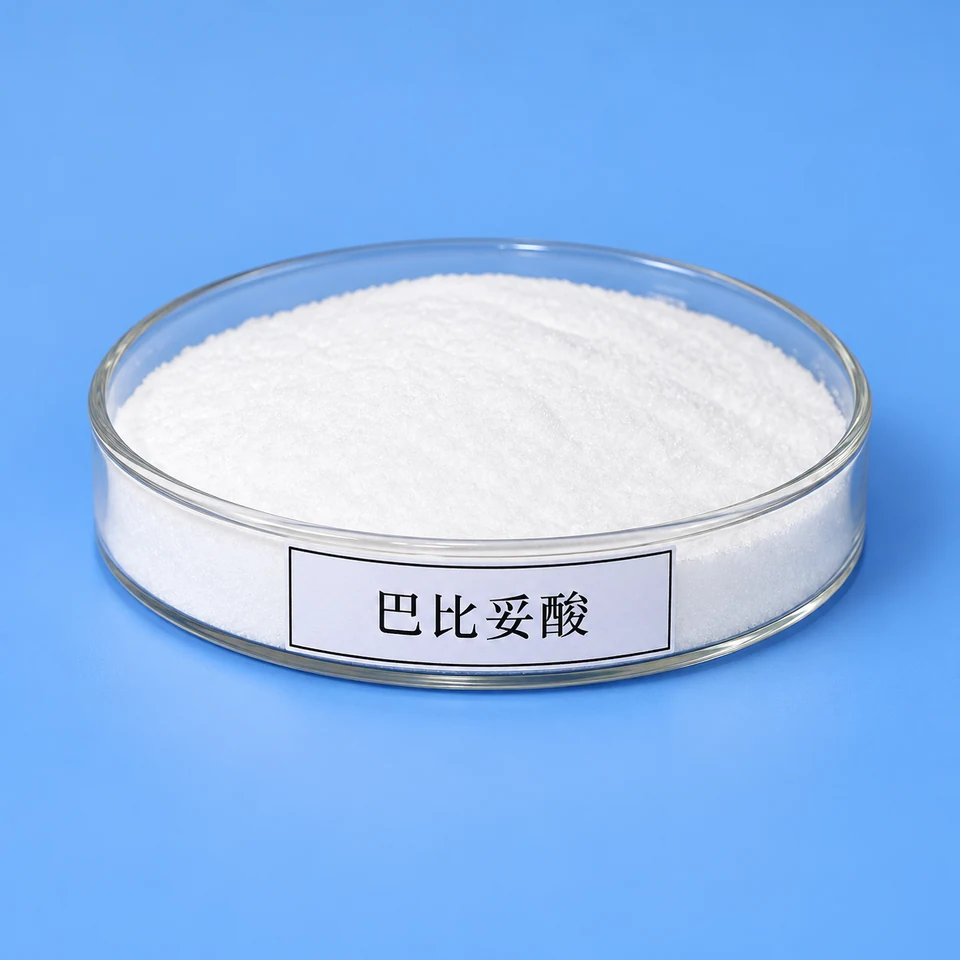
Technical specifications
Control Parameters
| Inspection Parameter | Standard |
|---|---|
| Content | 99% Min. |
| Loss on drying, % | 0.5% Max. |
| Melting Point | 245℃ |
| Sulfated ash | 0.1% Max. |
| Appearance | White Crystalline Powder |
Basic Information
| English name | Barbituric Acid |
| Molecular Formula | C₄H₄N₂O₃ |
| Molecular weight | 128.09 |
| CAS Number | 67-52-7 |
| Packaging | Packaging: 25 kg/bag, or as per customer request. |
| Storage | Store in a dry, well-ventilated warehouse, protect from direct sunlight, stack neatly, handle with care. |
Additional specifications and supply
| Parameter | Details |
|---|---|
| Packaging material | 25 kg plastic woven bags |
| Storage | Protect from sunlight, moisture and fire |
Product description
Product overview
Barbituric Acid is a white crystalline powder, CAS 67-52-7, molecular formula C₄H₄N₂O₃, molecular weight 128.09, content ≥99%. It is an important pharmaceutical intermediate used in the synthesis of barbital, phenobarbital, vitamin B12, and other drugs, and can also be used as a polymerization catalyst and dye raw material.
Product Features
- Content ≥99%, guarantee of high-purity quality
- Melting point 245°C, good thermal stability
- Loss on drying ≤0.5%, low moisture content
- Sulfated ash ≤0.1%, highest purity
- Standard for pharmaceutical use
- White crystalline powder, pure appearance
Chemical Properties
Barbituric acid belongs to the pyrimidinetrione class; its molecule contains two carbonyl groups and one imide structure. Its unique cyclic structure gives it weakly acidic properties; it can form salts with alkali metals. Barbituric acid is a key precursor for the synthesis of barbiturates; its derivatives have sedative, hypnotic, anticonvulsant, and other pharmacological activities.
Area of application
Pharmaceutical intermediates
Used for the synthesis of barbiturates such as barbital and phenobarbital, is a key raw material for sedative-hypnotic drugs.
Vitamin B12 Synthesis
Used in the synthesis of vitamin B12 (cobalamin), is an important raw material for vitamin preparations.
Polymerization catalysts
Can be used as a catalyst or catalyst ligand in polymerization reactions to synthesize specific polymer materials.
Dyestuff raw material
Can be used for synthesizing dye intermediates and functional pigments containing pyrimidine structure.
- Store in a dry, well-ventilated area, protect from direct sunlight.
- Stack carefully, handle with care, avoid damaging packaging
- Keep the packaging tightly closed before and after use.
Frequently asked questions
The barbituric acid content in this product is ≥99%, purity controlled by HPLC, ensuring compliance with pharmaceutical standards. Low impurity levels ensure efficacy and safety in various applications.
The melting point of barbituric acid is 245°C; this is an important physical parameter characterizing the purity of the compound. High-purity barbituric acid should have a clear melting point close to the theoretical value. A lowered melting point or a widened melting range may indicate the presence of impurities in the product, so melting point testing is an important quality control step.
Sulfated ash ≤0.1% is an important indicator for evaluating the content of inorganic impurities in the product. A low sulfated ash value indicates the virtual absence of inorganic salt impurities, which is crucial for the purity requirements of pharmaceutical intermediates. High product purity ensures the efficiency of subsequent synthetic reactions and the quality of the final product.
Barbituric acid has the molecular formula C₄H₄N₂O₃ and a molecular weight of 128.09. Its pyrimidine-ring structure contains two carbonyl groups (>C=O) and one imide group (-NH-CO-). This cyclic structure gives it weakly acidic properties, enables salt formation with alkali metals, and makes it an important precursor in barbiturate synthesis.
Barbituric acid is readily soluble in hot water and alkaline solutions, slightly soluble in cold water and ethanol, and insoluble in diethyl ether and chloroform. Its aqueous solution is acidic and can react with bases to form corresponding salts. Solubility increases significantly under alkaline conditions, which is a common way to dissolve it in pharmaceutical synthesis.
Under proper storage conditions (dry, ventilated place, protected from direct sunlight), product shelf life can reach 24 months. Recommended storage indoors at 15-25°C, keep packaging sealed to prevent moisture absorption. When stacking, handle with care to avoid damaging packaging.
When handling, use protective gloves and a mask, avoid inhaling dust and skin contact. In case of accidental contact with eyes or skin, rinse immediately with plenty of water. When used as a pharmaceutical intermediate, work under conditions meeting GMP requirements. For detailed safety information, refer to the product Material Safety Data Sheet (MSDS).
Both are pyrimidine compounds but have different structures. Barbituric acid (C₄H₄N₂O₃) contains two carbonyl groups and one imide structure, exhibiting weak acidity; whereas 4,6-dihydroxypyrimidine (C₄H₄N₂O₂) contains two hydroxyl groups. Structural differences lead to differences in chemical properties and applications; barbituric acid is mainly used for the synthesis of sedative drugs.
Standard packaging: 25 kg/bag, paper bags with PE liner for effective moisture protection. We also support custom packaging per client request, such as carton drums, plastic pails, and other packaging types. For bulk purchases, IBC container packaging is available.
Send Inquiry
Please fill in the following information, our commercial team will contact youWithin 2 working daysWe will reply to you.
Products of the same series
More options of other chelating agents